Healthcare interface · 2026

A bedside companion that supports autonomy for nursing home residents.
- Role
- UX researcher & designer
- Type
- Individual, school
- Platform
- Tablet
- Tools
- Figma
- Timeline
- 7 months
The problem
Nursing home residents have no tools built for their daily lives.
Most live with cognitive limitations and sensory decline, and have a deep need for autonomy and connection. Yet every existing solution is built for short-term hospital care, blind to the realities of long-term living.
The solution
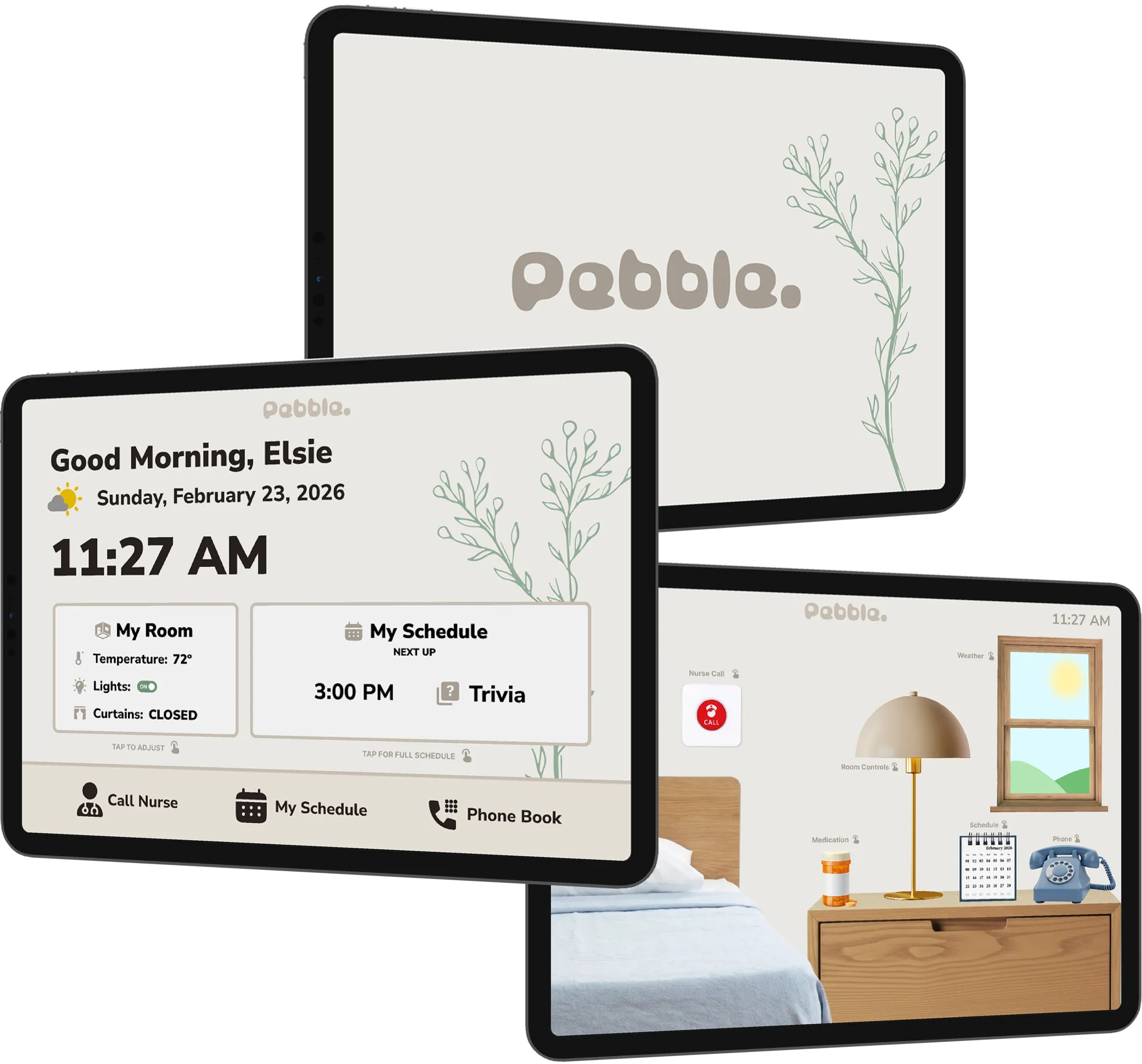
A purpose-built interface that restores autonomy and connection.
- Elderly-first, non-stigmatizing design. It looks like an everyday device, not medical equipment.
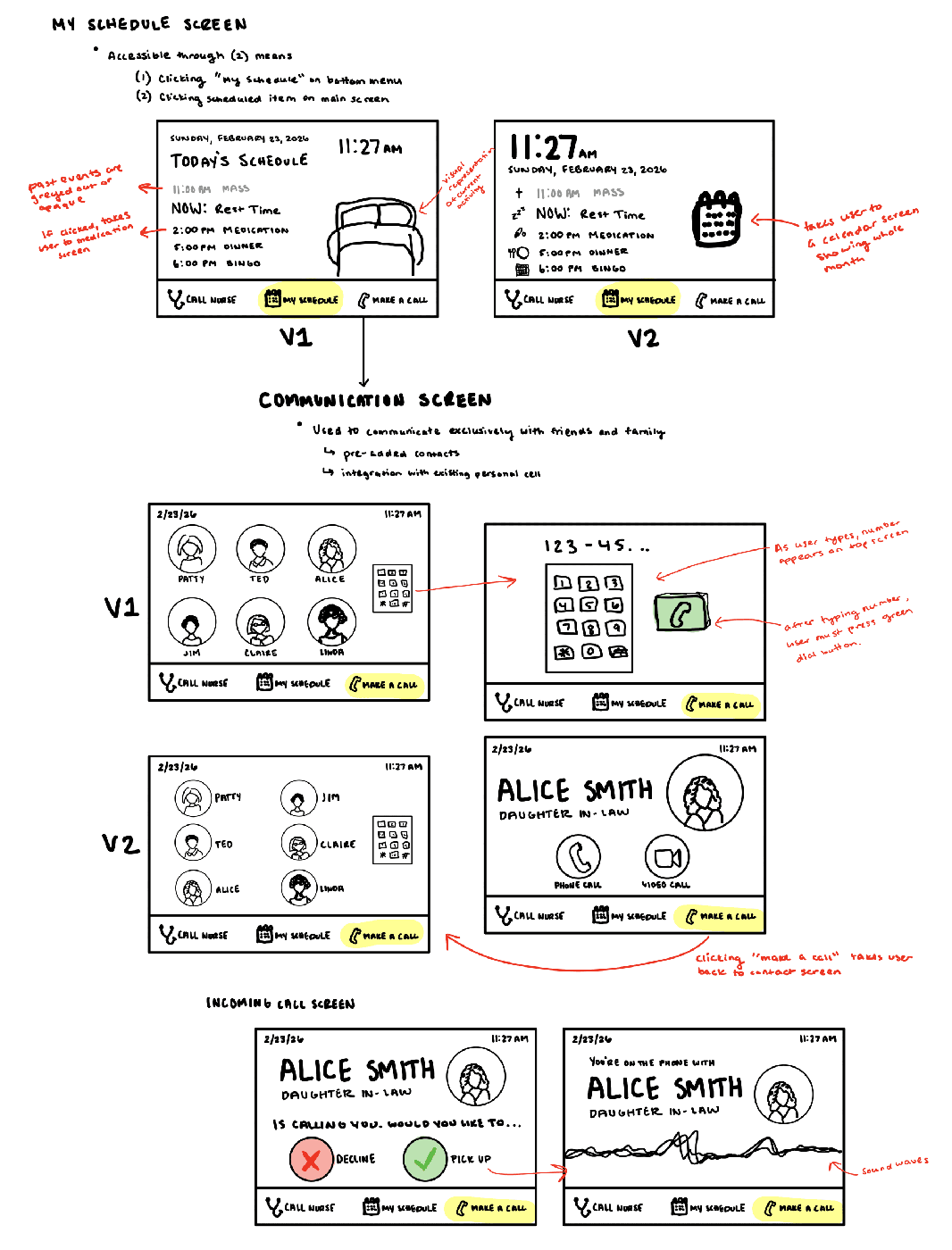
- Schedule, medications and activities. Always visible, so residents stay oriented without asking.
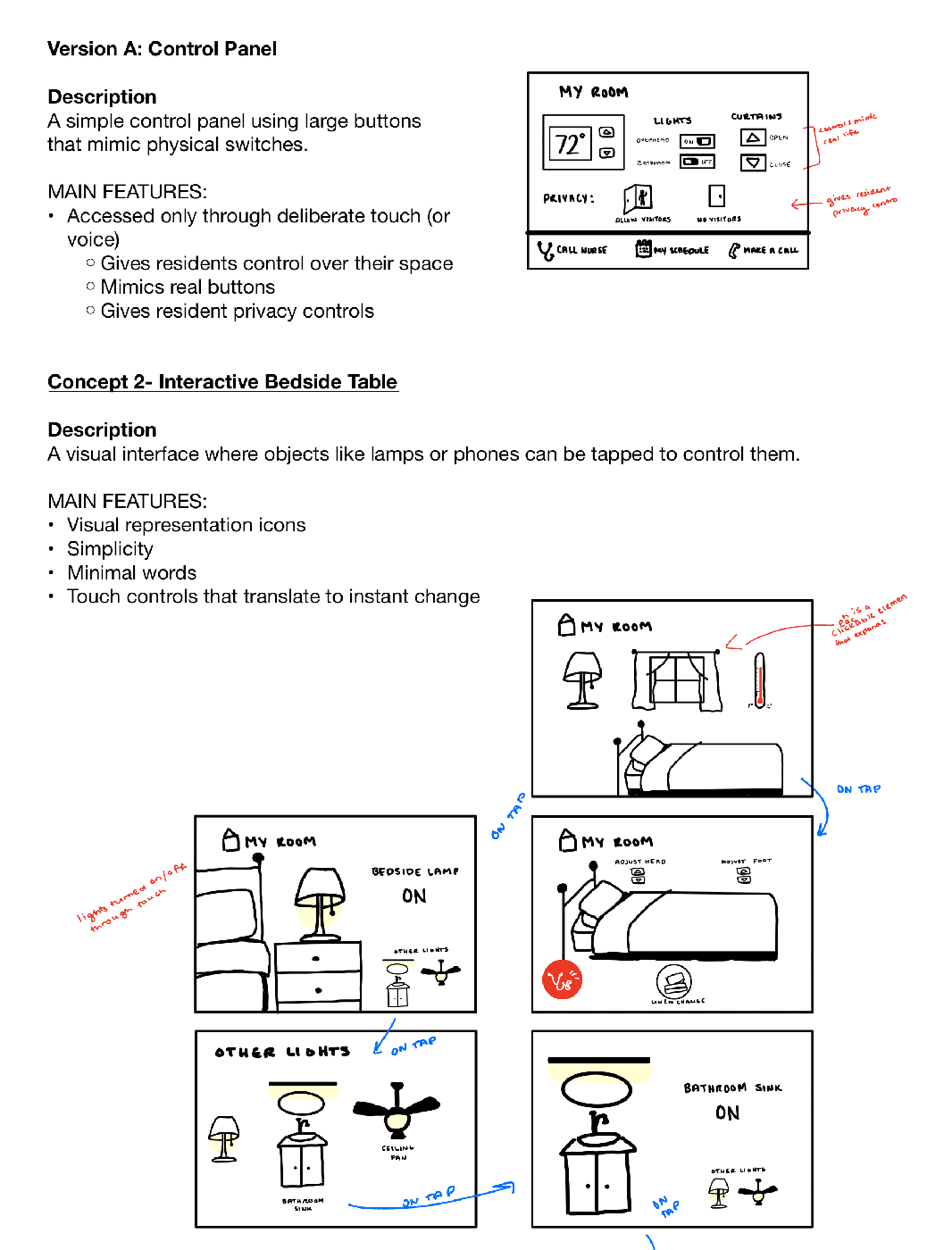
- Room controls and privacy. Temperature, lights, curtains, and who can visit.
- Nurse call and symptom communication. Say what’s wrong, not just that something is.
- Family and social connection. Calls by photo, and reminders that lead to real activities.
The ambient dashboard
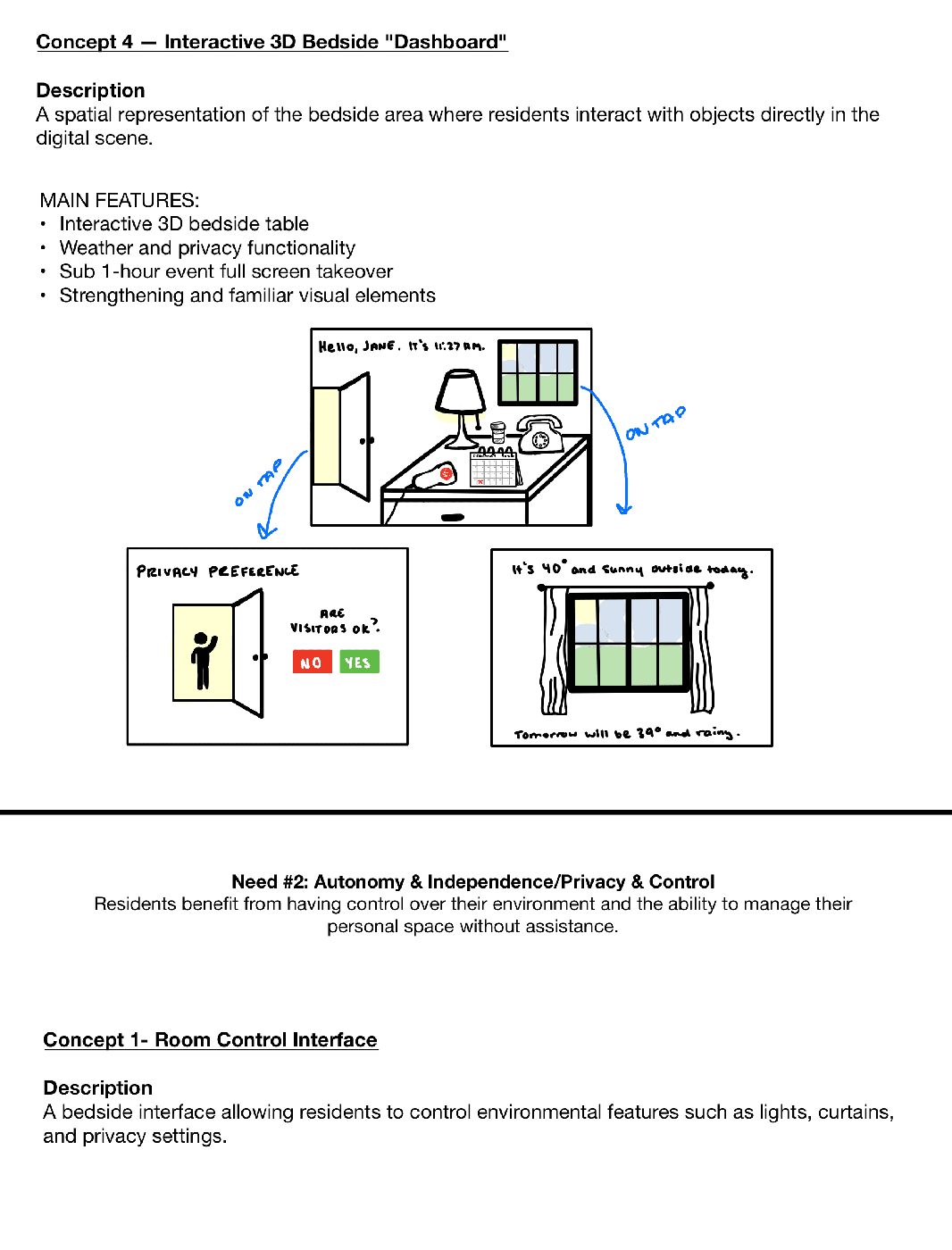
The 3D room mode
Why “Pebble”
A pebble doesn’t demand attention. It sits quietly and does exactly what it’s meant to do.
The name comes from the project’s central inspiration, the zen garden: calm, intentional, free of noise, with every element placed on purpose and nothing superfluous. That became the guiding principle behind every design decision.
The process
Technology should open a door to people, never replace them.
- Literature review
- 11 peer-reviewed sources
I synthesized research on elderly technology adoption, cognitive decline, digital accessibility and long-term care design, to build a research-backed map of unmet needs instead of relying on assumptions.
One principle shaped the scope: in care settings, technology should be an extra way to reach human relationships. So Pebble has no entertainment features. If there’s a yoga class at 2pm, Pebble’s job is to remind you to go, not to stream a yoga video instead.
of long-term care residents have cognitive limitations, most often dementia. Bowles et al., 2015
Standardized technology “paradoxically contributes to a decrease in residents’ independence.”
Jøranson et al., 2025
Older adults prefer technology “disguised as an everyday device,” not medical equipment.
Mannheim et al., 2019
Ten resident needs emerged
- Autonomy and independence
- Social connection
- Cognitive and memory support
- Safety and health monitoring
- Pain communication
- Dignity and non-stigmatizing design
- Privacy and control
- Personalized information
- Accessible design for sensory decline
- Human connection over mechanization
Residents need support, without feeling surveilled, infantilized or dependent.
- Firsthand observation
- Part-time nursing home work
I came into this project working part-time at a nursing home, so I had direct, ongoing access to the people I was designing for.
I saw firsthand that residents lacked meaningful control over their immediate environment (temperature, lighting, reaching a nurse) and had limited, dependent access to family. That observation anchored the entire project.
Design principle
The goal was never to build a smarter device. It was to restore a sense of agency, quietly, without calling attention to what the technology was doing.
Any interface would have to thread that needle carefully: support that never feels like being watched or managed.
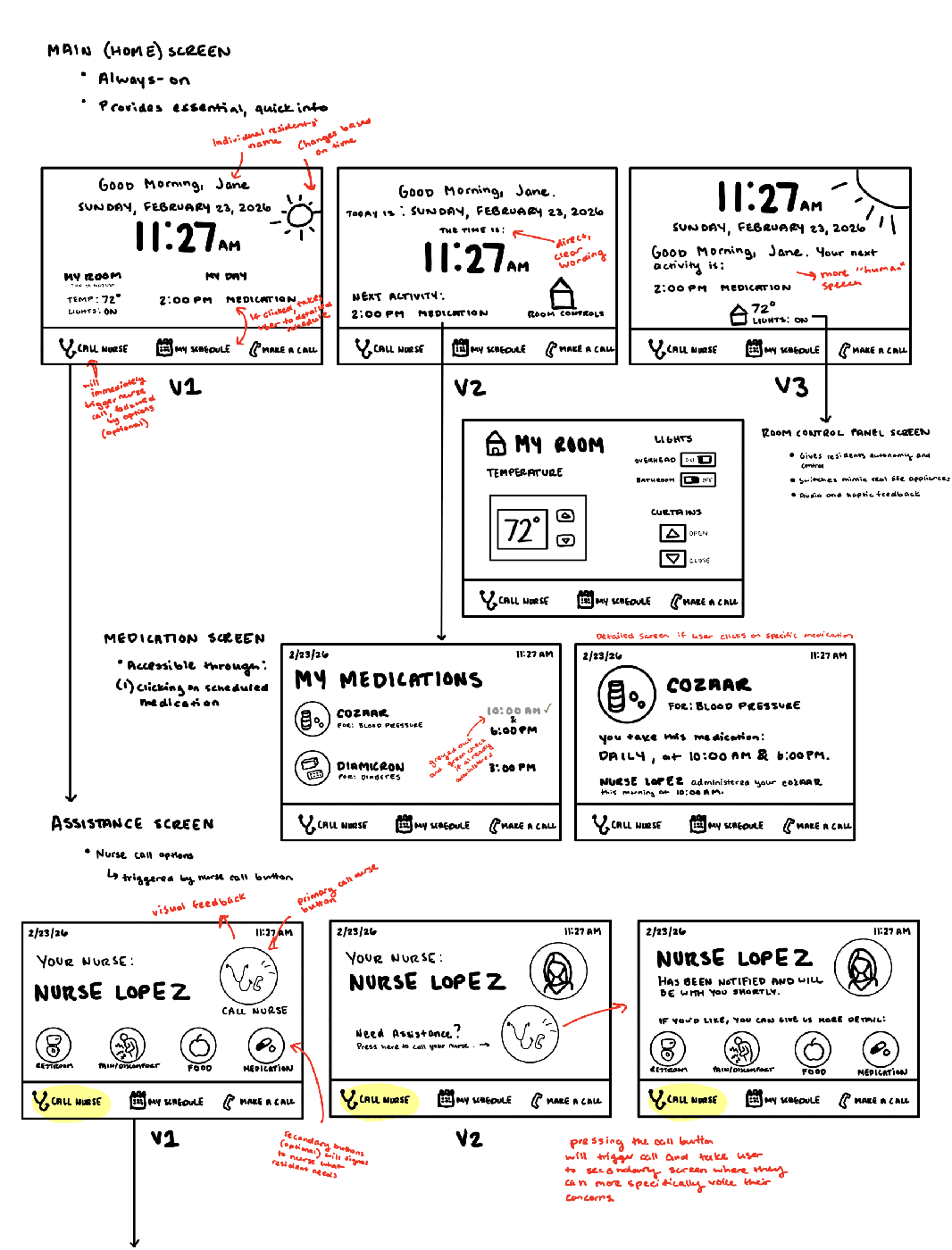
Three rounds of sketching, each pushed back to first principles by critique.
Round 1: a functional dashboard
Home, schedule, medication, calls and nurse call. The critique: technically sound, but nothing new. You could already do all of it on an iPad. My professor pushed me to ask not “what does this screen show?” but “what does a resident feel when they look at it?”
Round 2: designs mapped to needs
Directions built around reassurance, orientation, identity and environmental control. The critique: the same information in different layouts, not genuinely different ideas.
Round 3: the breakthrough
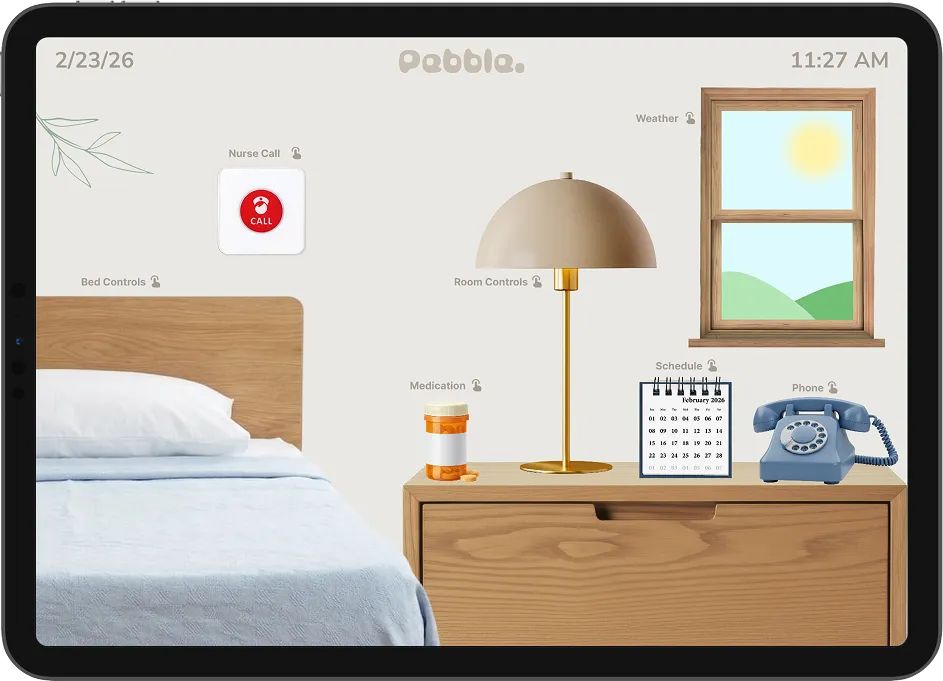
The zen garden became both a visual reference and a philosophy. I stopped designing screens and started designing a cognitive support object, something that quietly works for residents instead of something they have to learn. That led to the dual dashboard and the 3D room model.
Pivot moment
My professor asked: how is this different from a phone? I realized I had to go beyond a new layout, and design something genuinely new in how it could help residents.
Three core functions, each built for a cluster of resident needs.
Ambient home screen
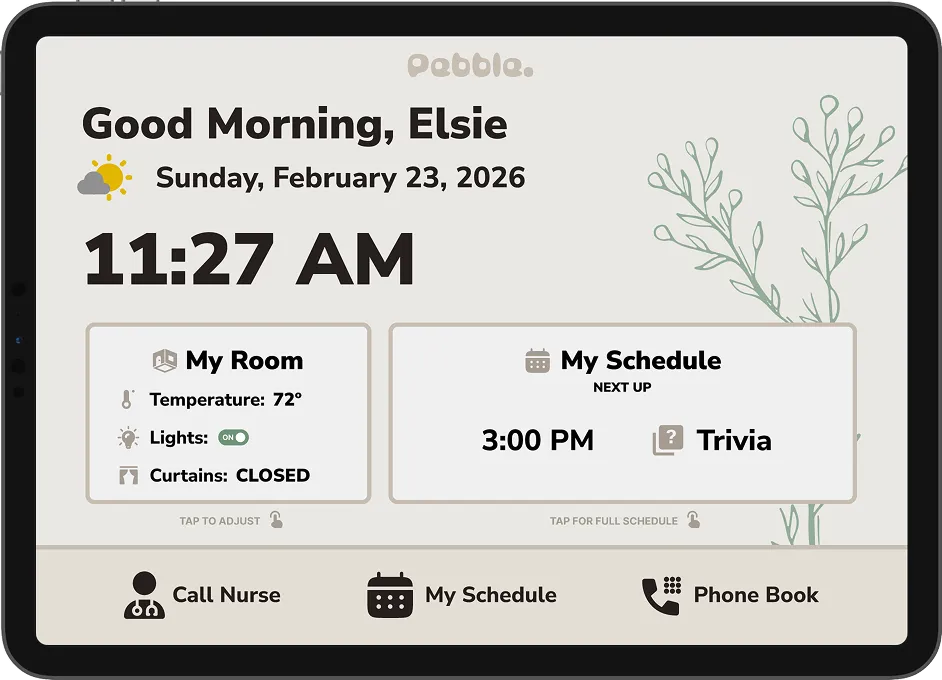
Always-on clock, schedule and medication reminders that orient residents without needing a tap.
Environment & care controls
Temperature, lighting, nurse call, specific requests like bedding or the bathroom, and do-not-disturb.
Communication hub
Video and voice calls with faces up front, large targets, audible alerts and clear caller ID.
Key decisions
- Skeuomorphic, button-like controls instead of flat arrows. Research showed residents struggle to recognize flat elements as tappable.
- Contacts shown by face, so callers are recognized by photo rather than by reading a name.
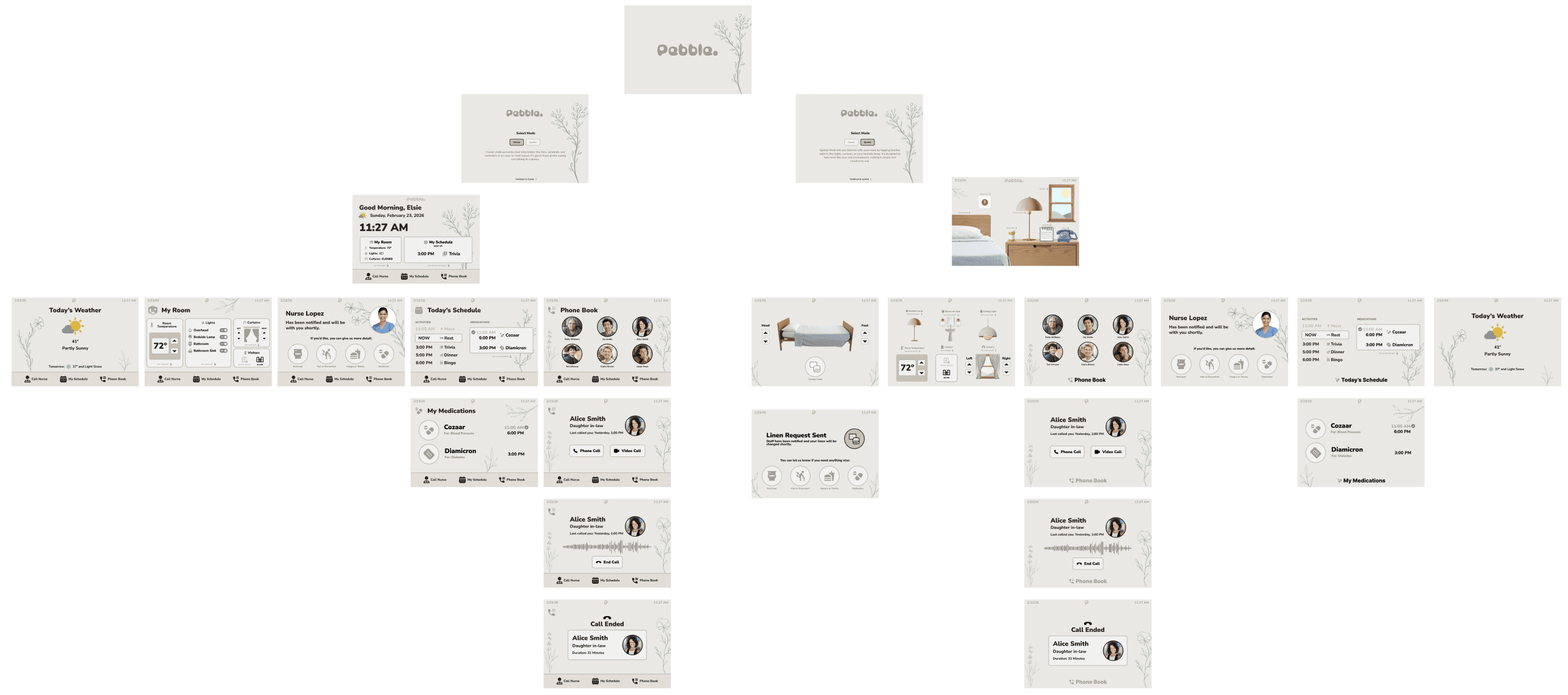
- A dual dashboard: a structured text view, or a visual 3D mode. Residents choose how they want to interact.
- Activity reminders that motivate people toward real programming (“Bingo is at 3. Let’s go!”) rather than replacing it.
- Privacy framed as personal preference (do not disturb, no visitors), not as a medical setting, to preserve dignity.
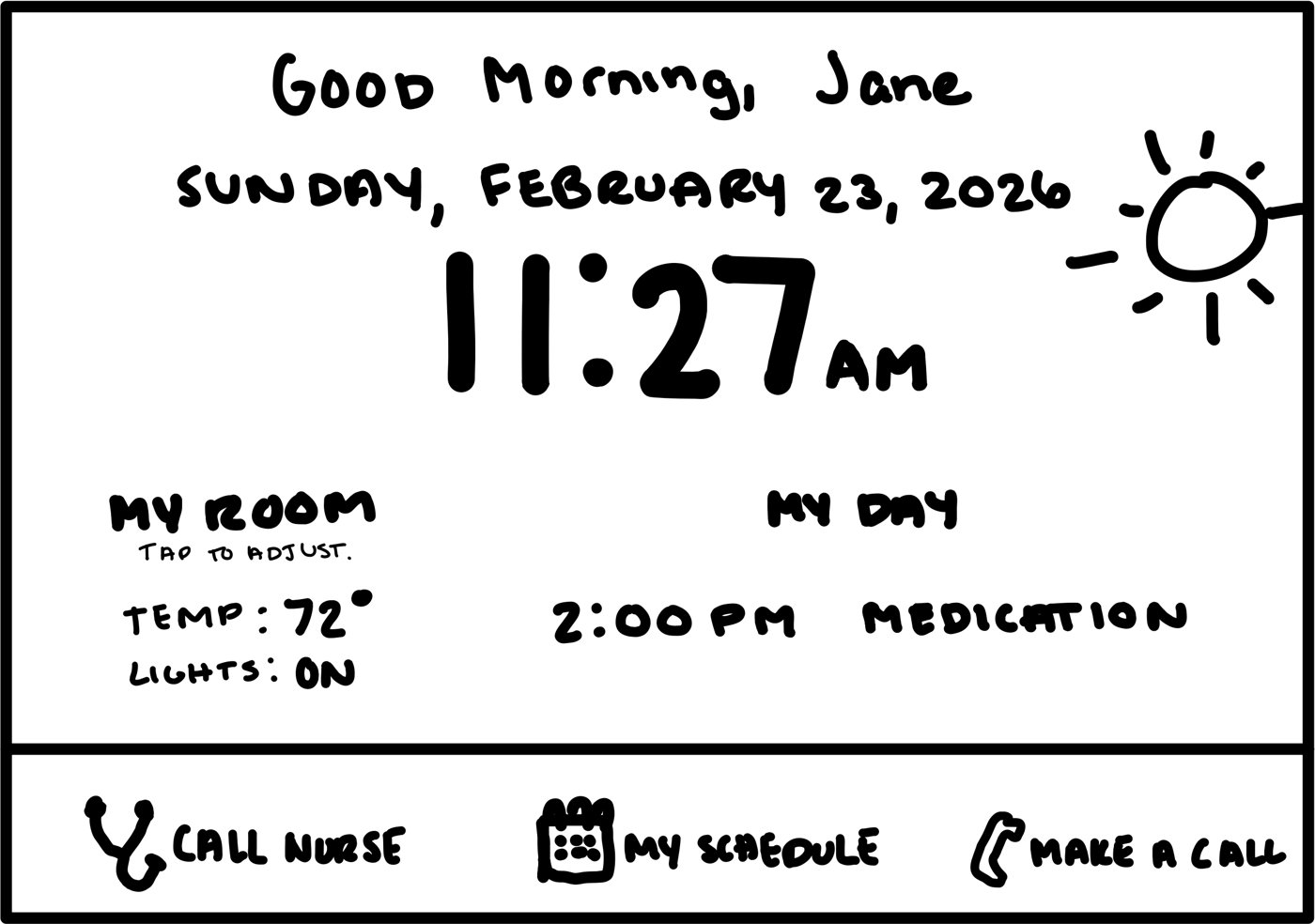
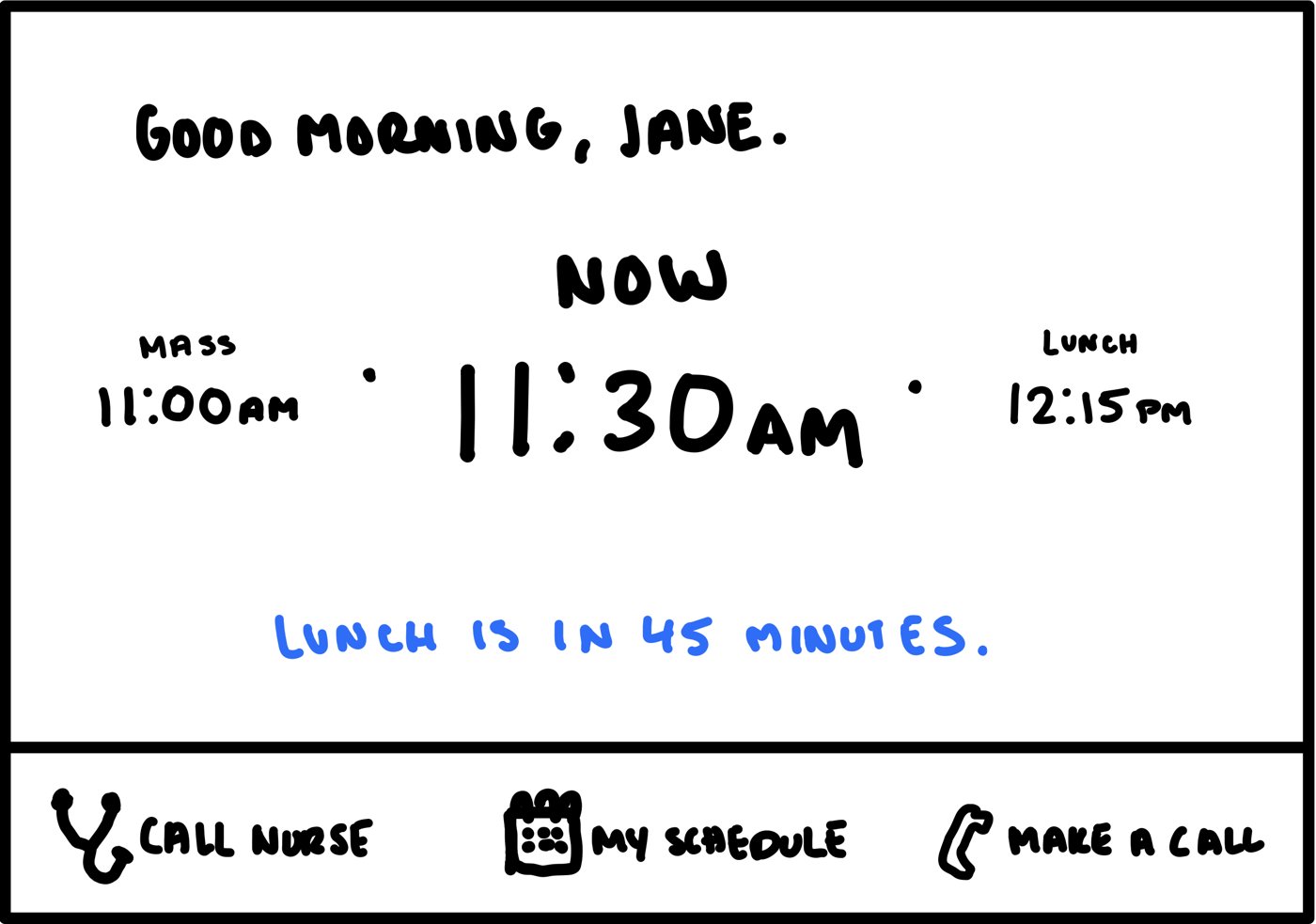
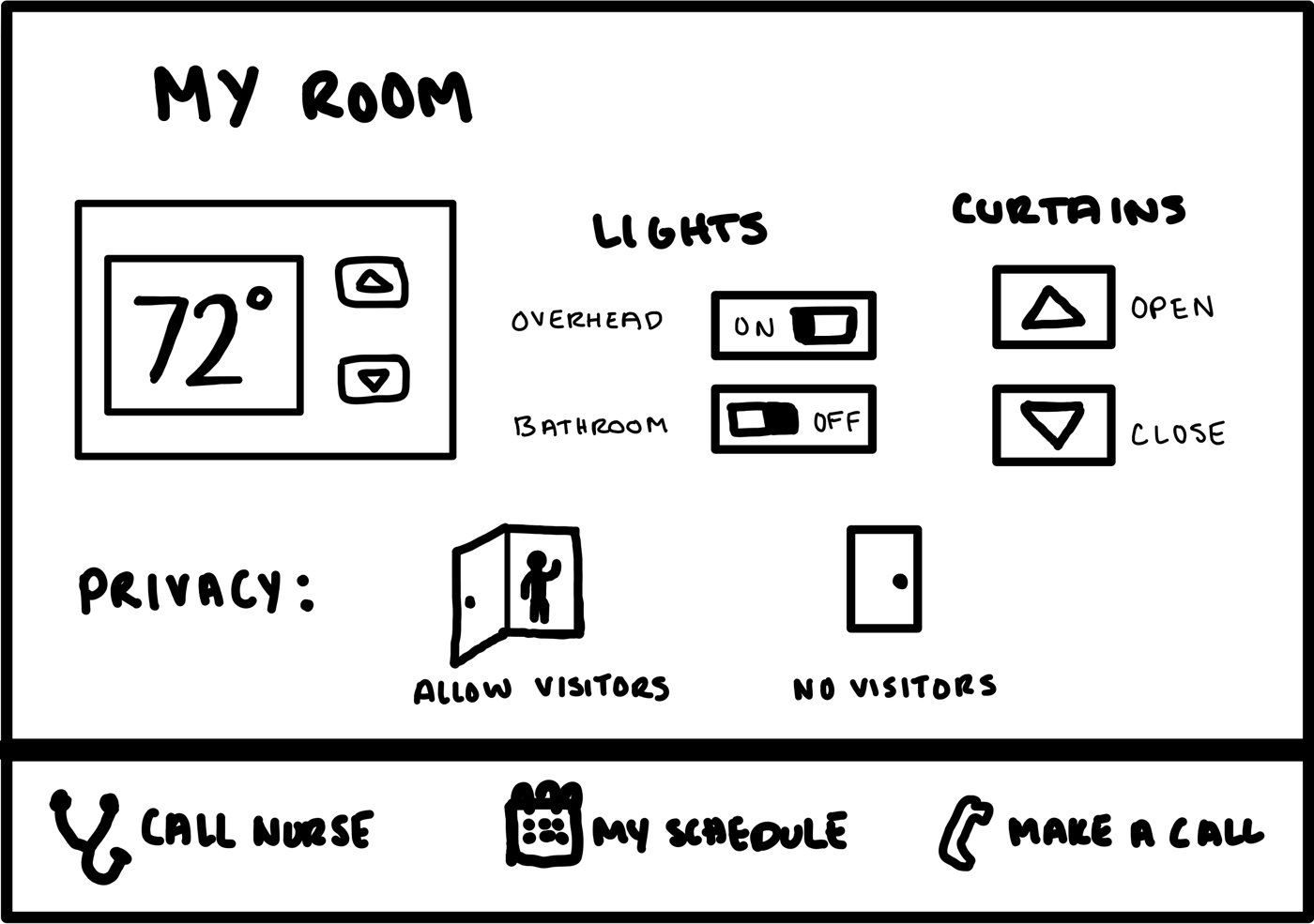
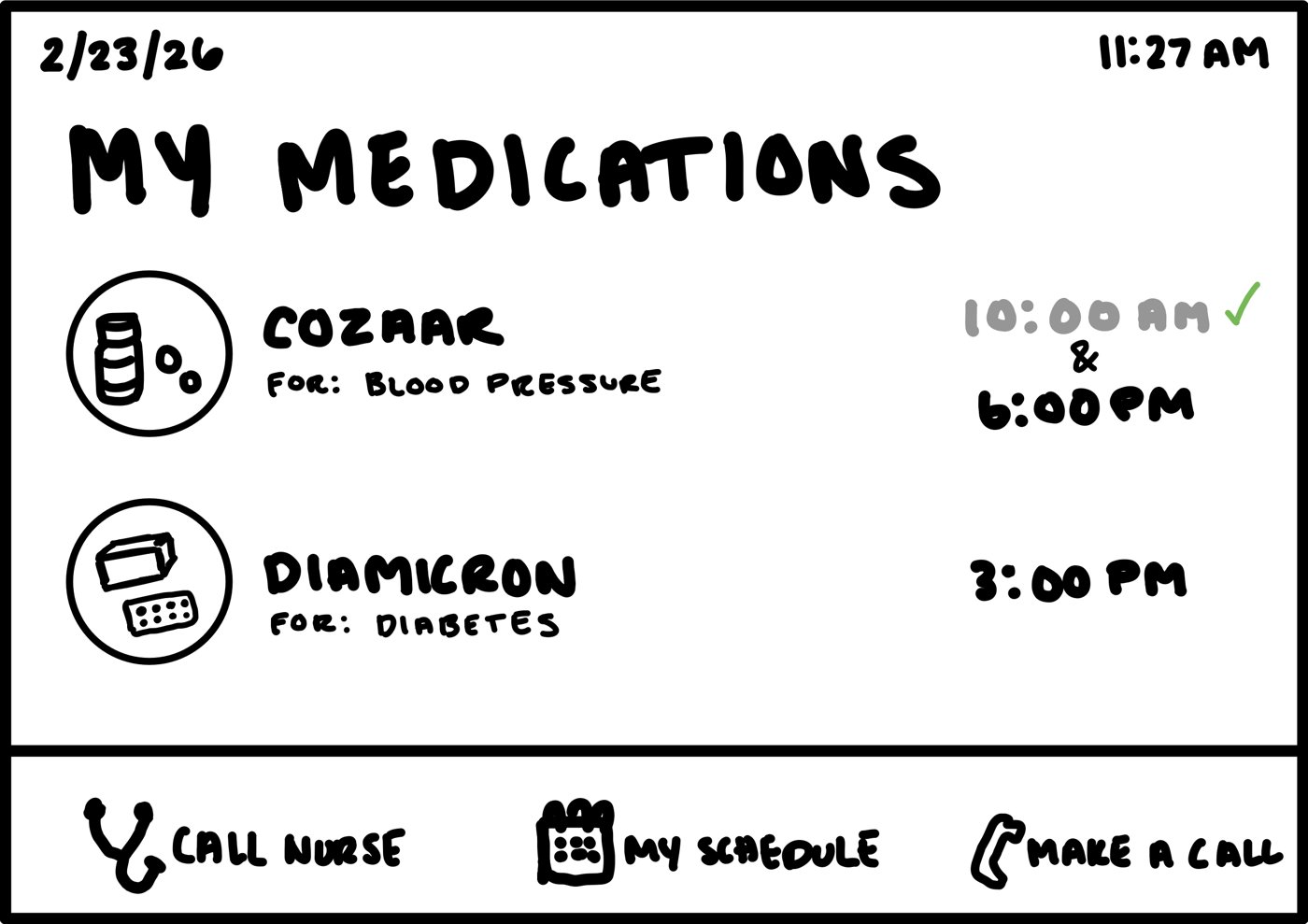
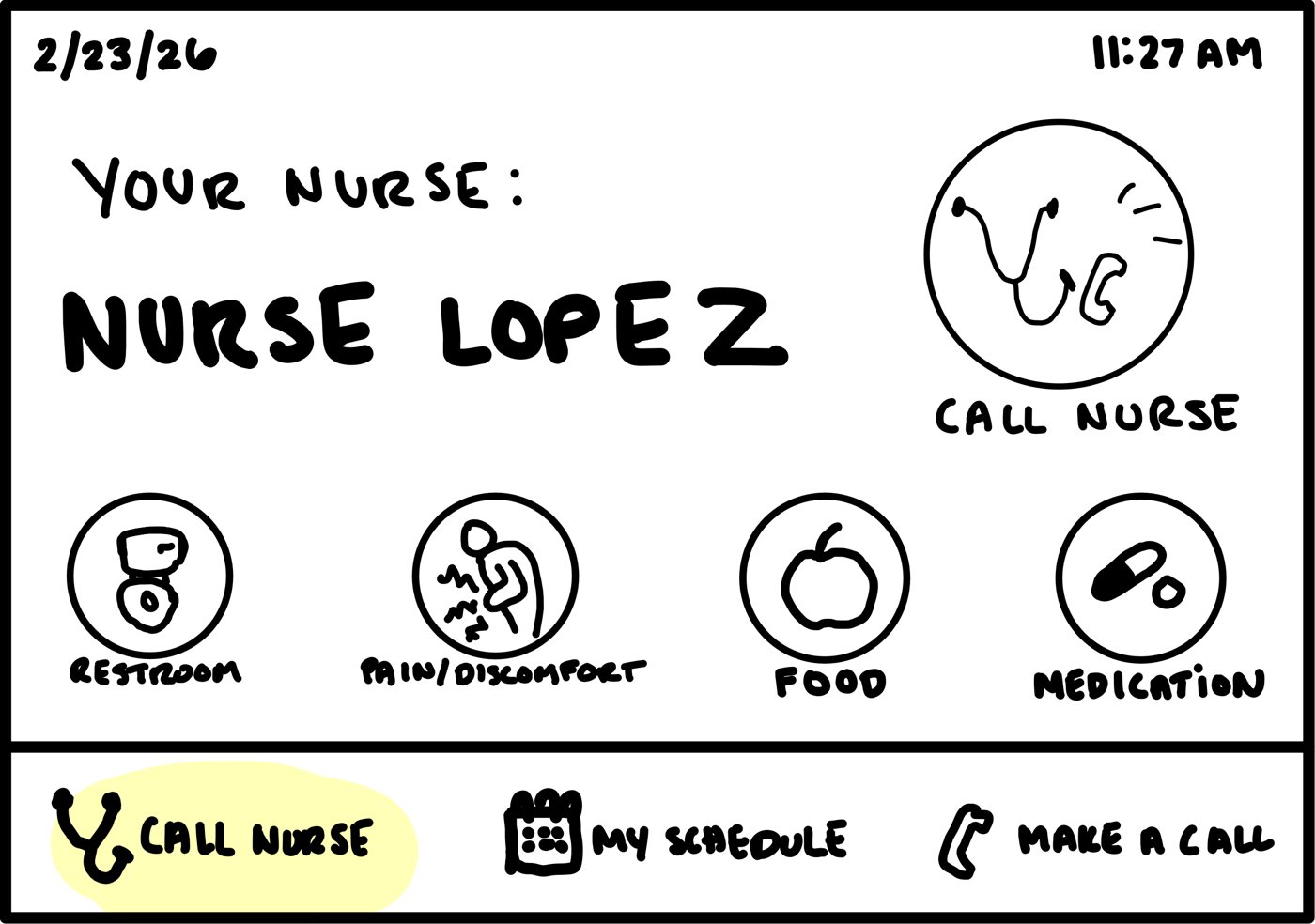
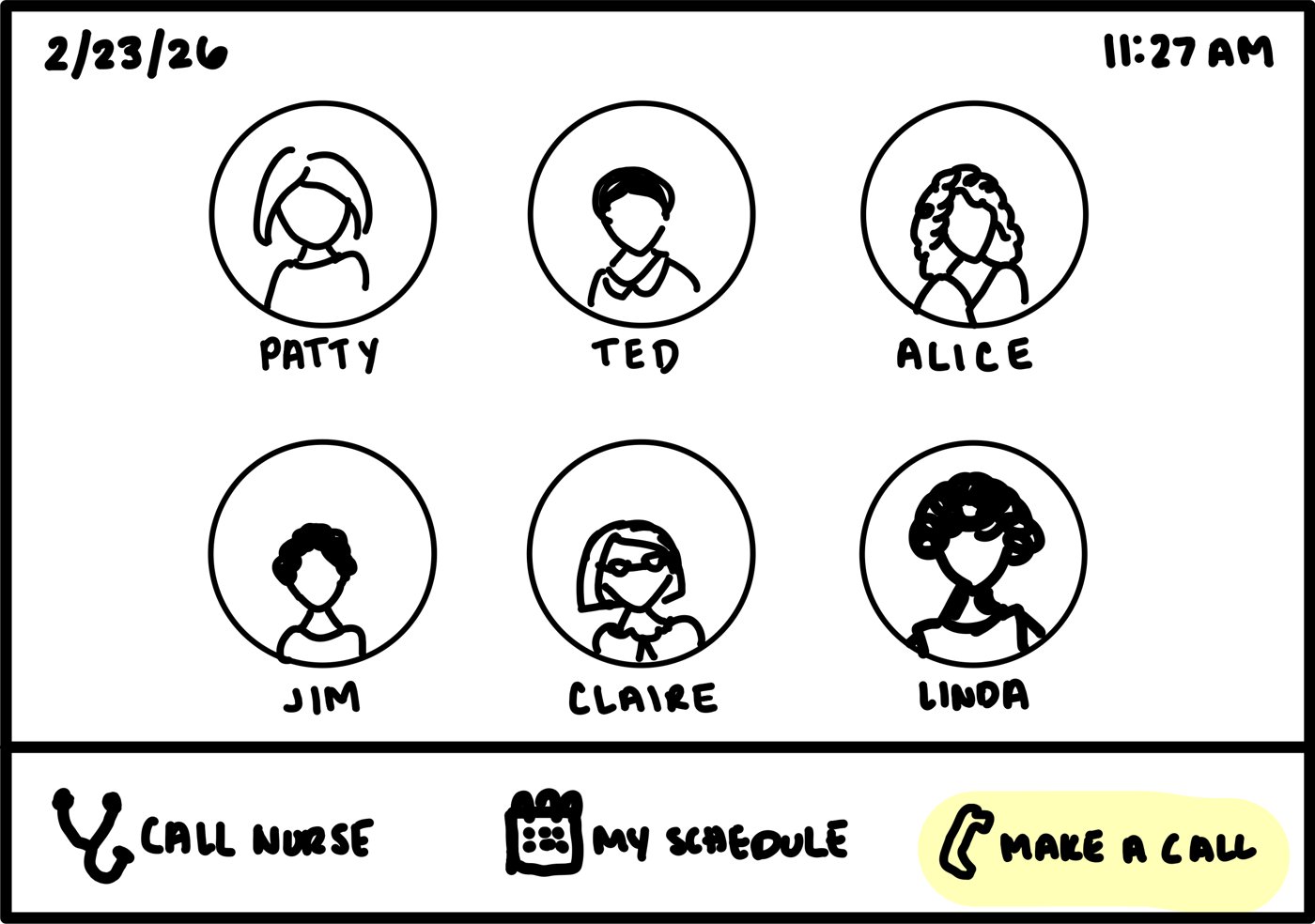
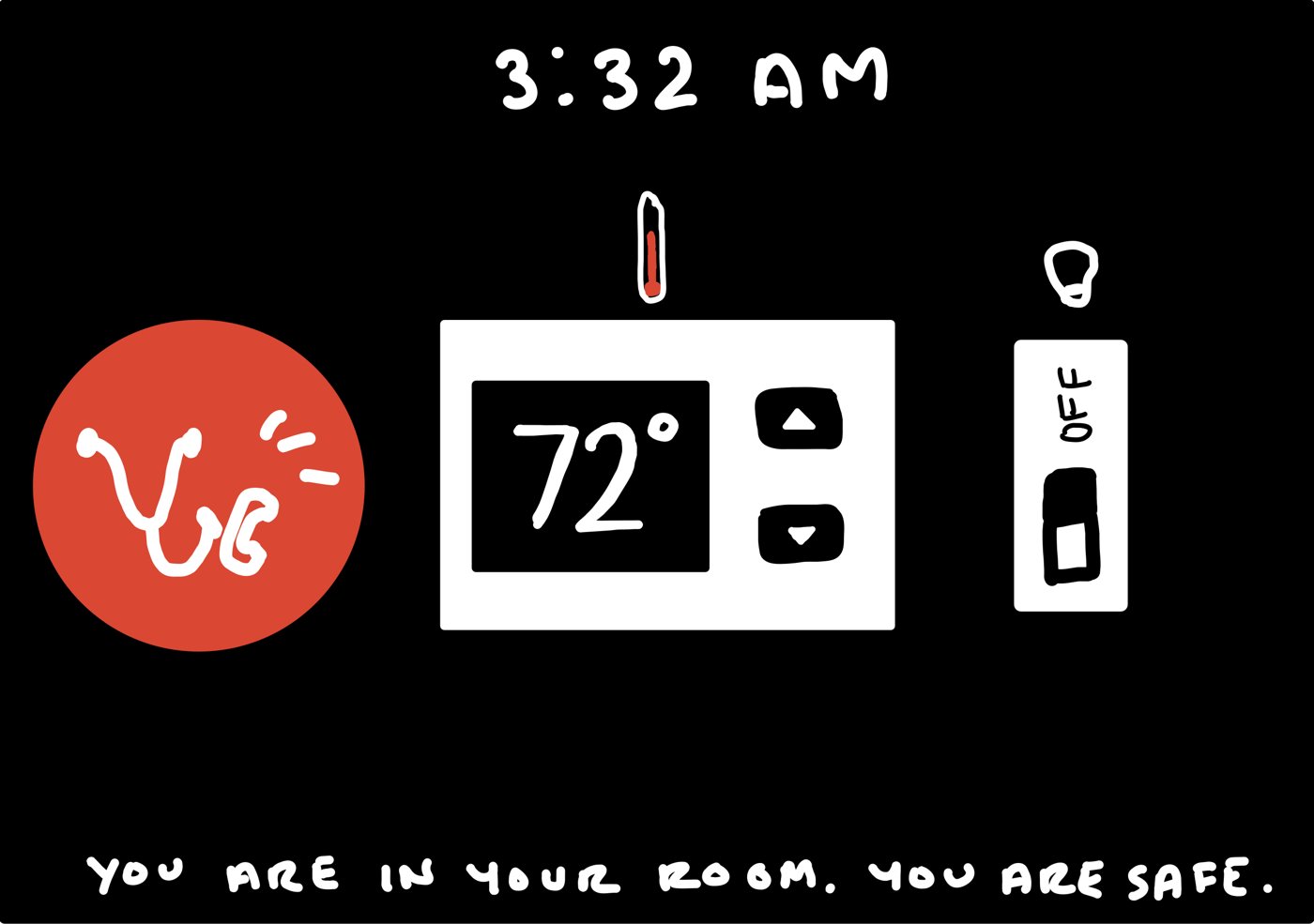
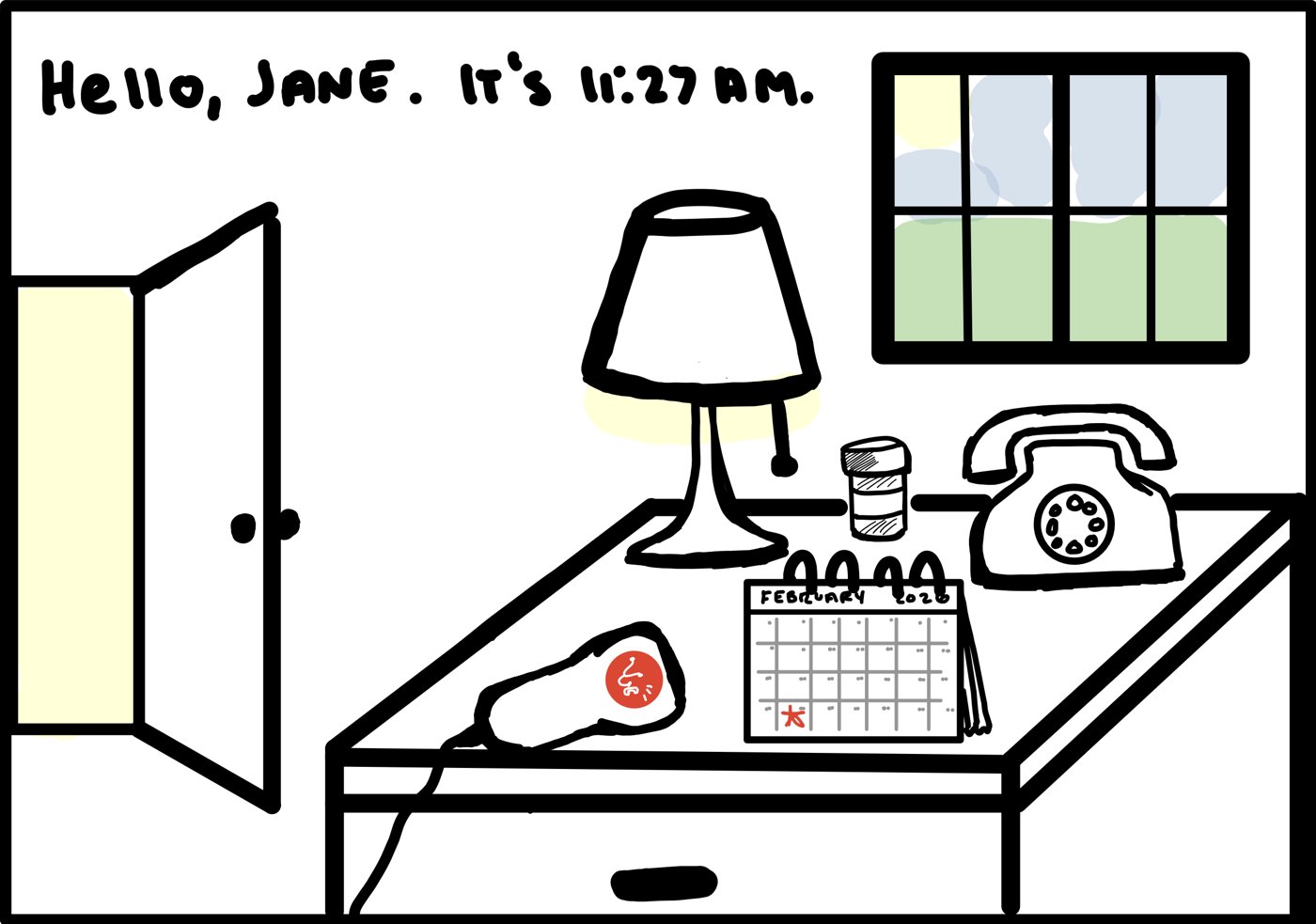
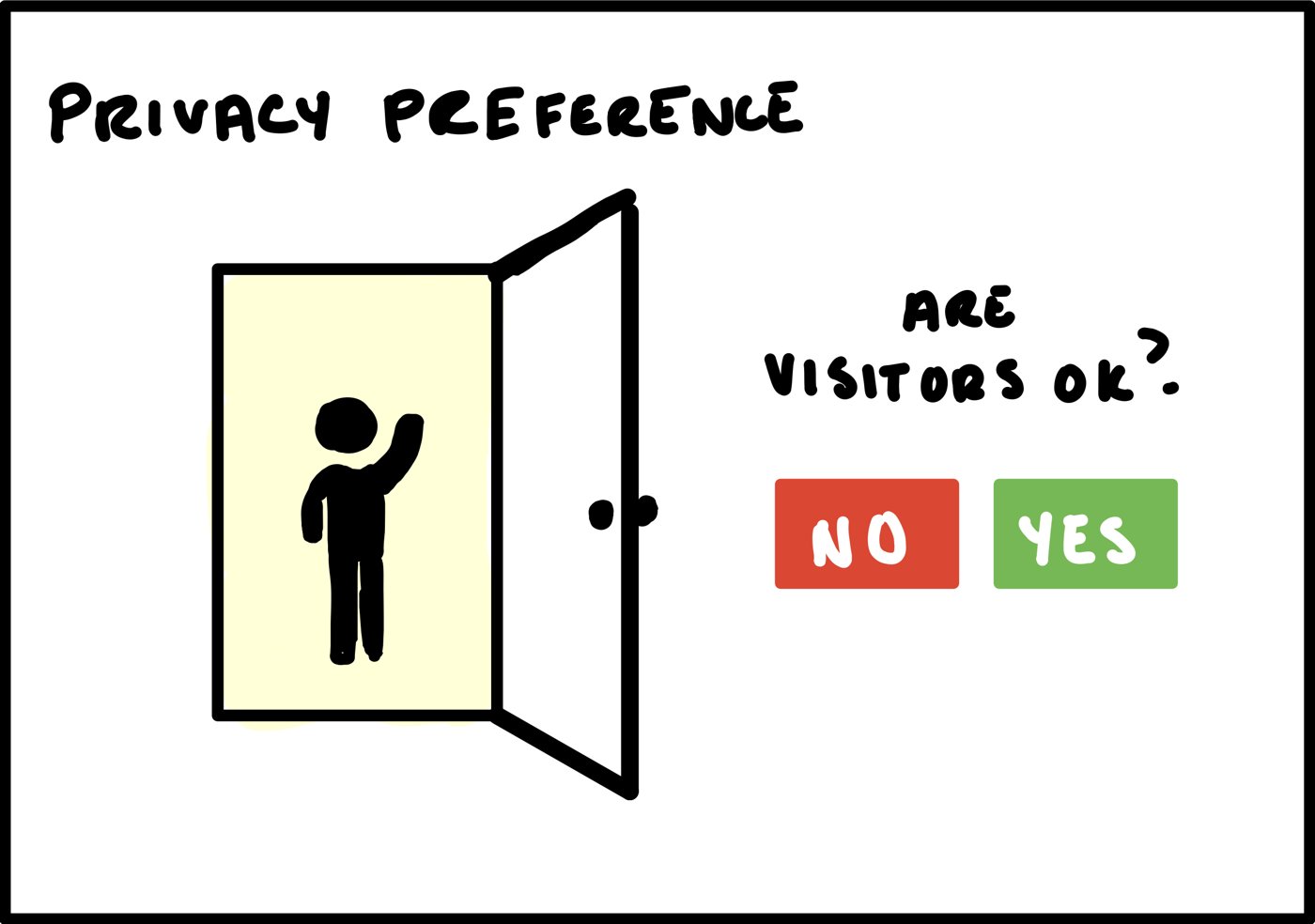
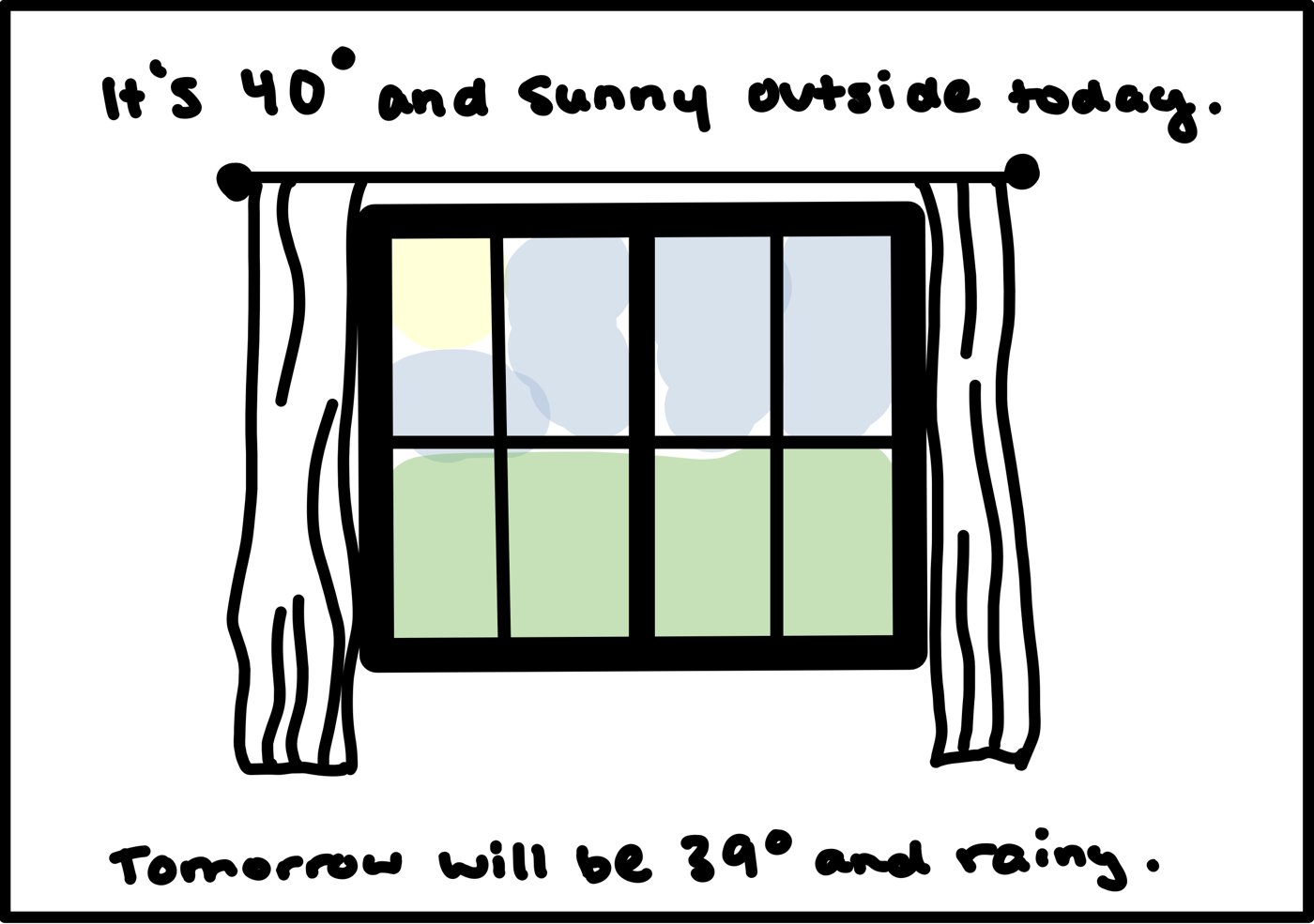
Residents trusted labels over metaphors, so Pebble lets them choose.
- Usability testing
- 3 participants, ages 62–69
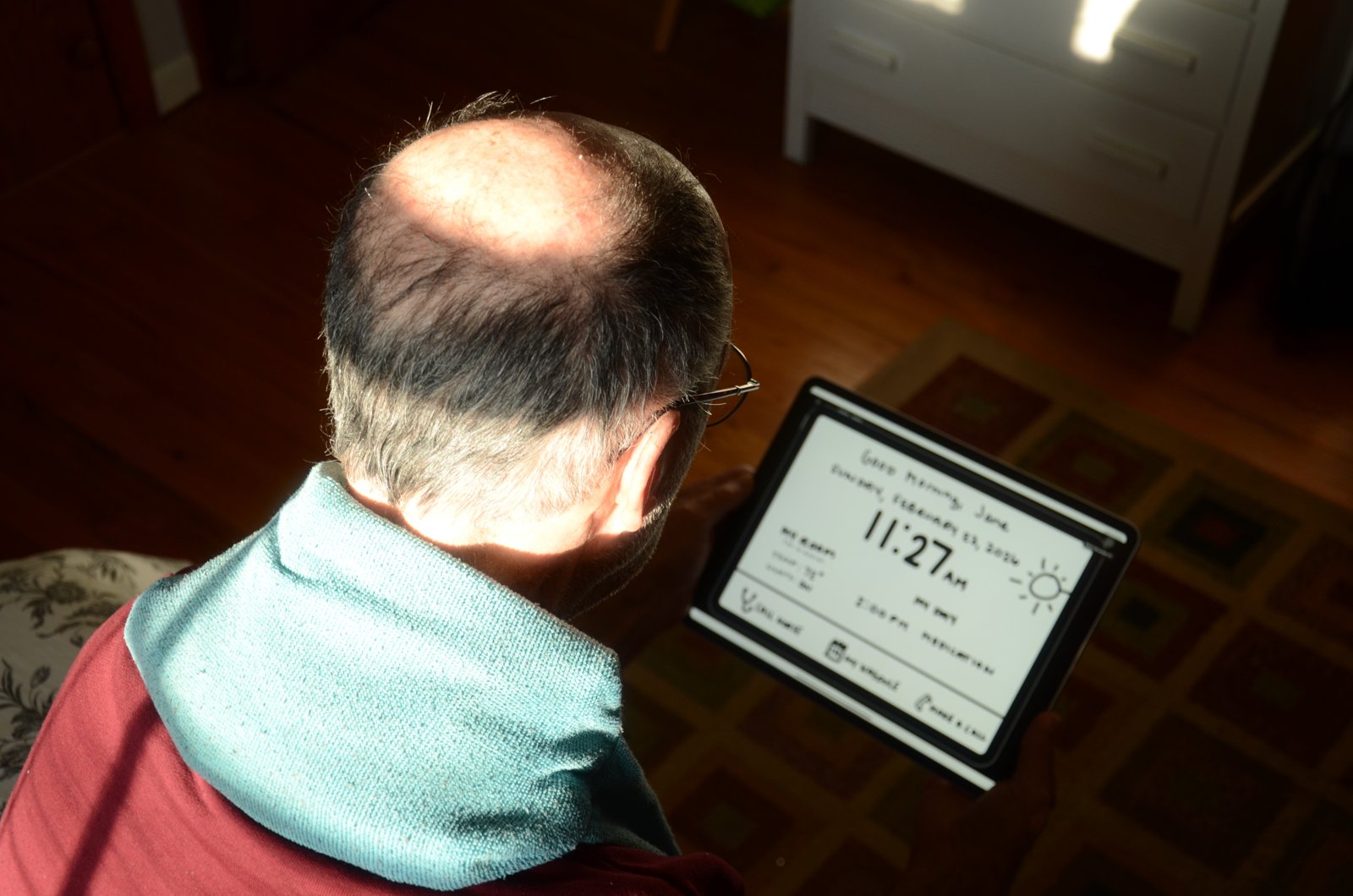
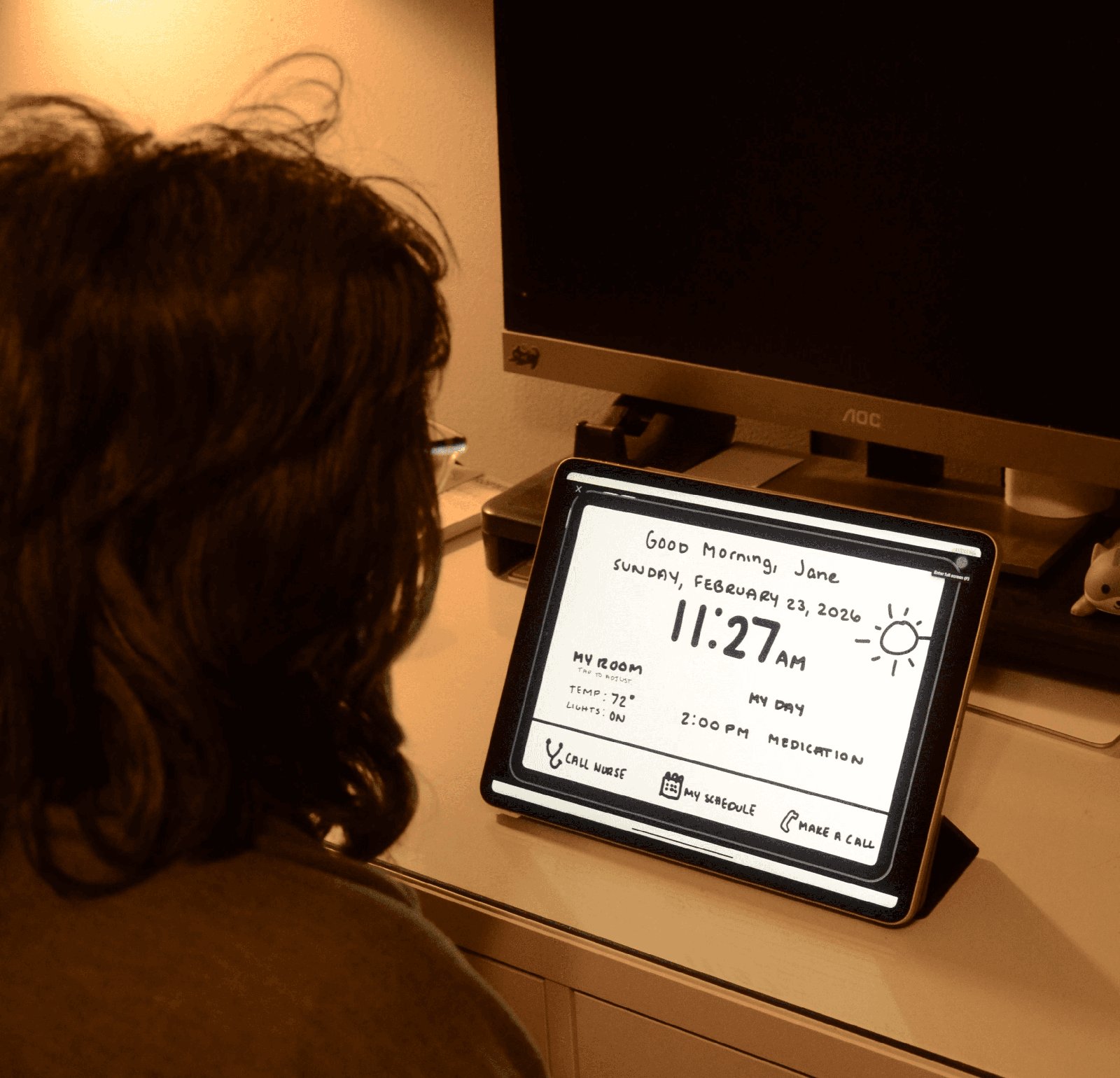
Across all three participants, one pattern stood out: they defaulted to the labeled bottom navigation instead of the visual elements. Even the most carefully considered metaphor needs to be legible on first contact.
That led to a refinement: a dual dashboard, where residents choose between a structured text view and a visual 3D mode. Clarity and calm look different for different people.
What worked
- The nurse call button, understood by everyone.
- The bottom navigation bar.
- Schedule and medication labels, and at-a-glance information.
- The 3D dashboard, called engaging and intuitive for a quick overview.
What didn’t
- Swipe gestures. No one discovered them on their own.
- The “My Room” lamp icon, which wasn’t recognized.
- Tap-to-reveal interactions.
- Icon-only metaphors like the door (privacy) and window (weather).
Interactive prototype
Can AI do this?
I gave Google Stitch the same problem, four times.
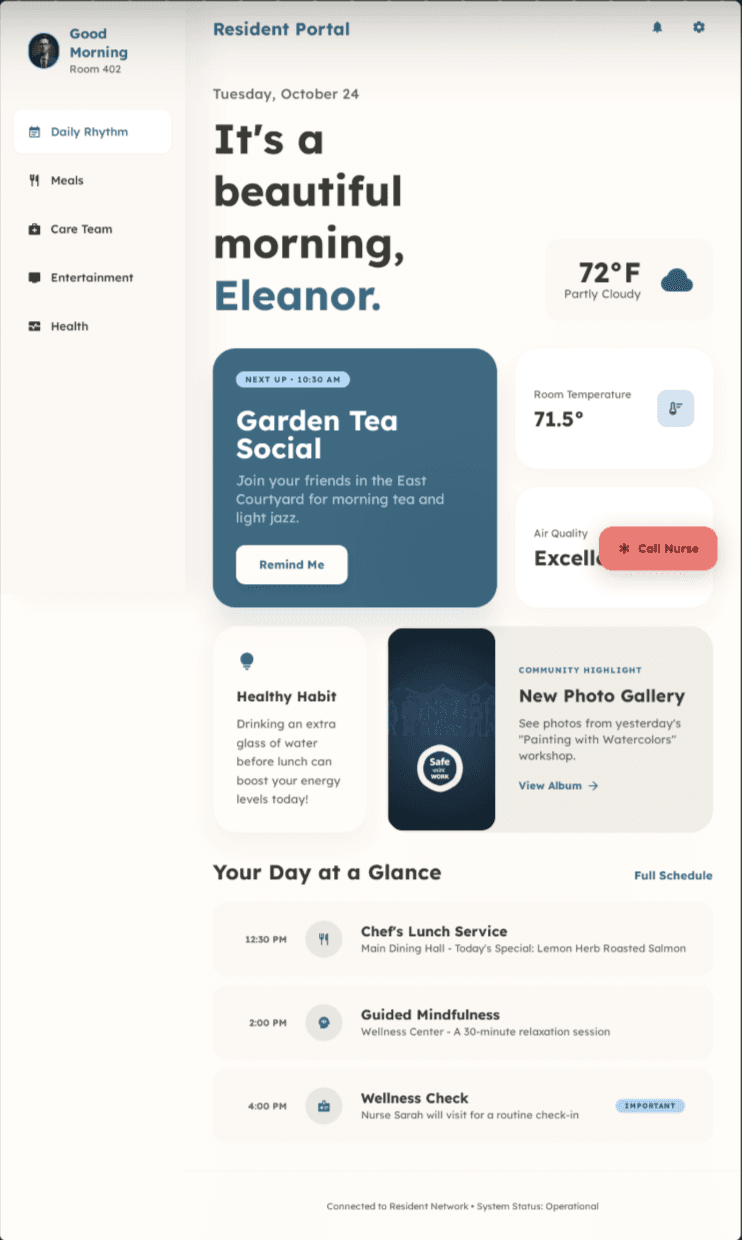
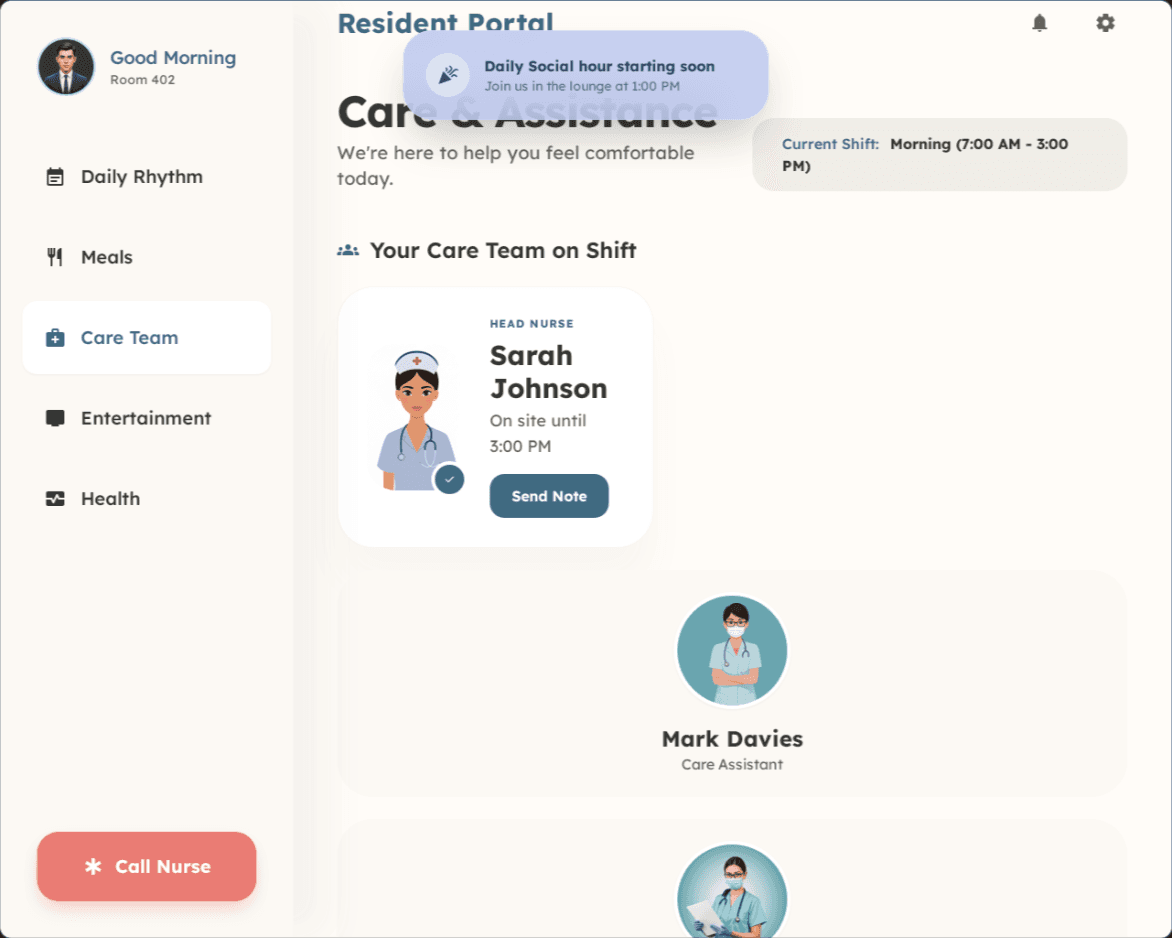
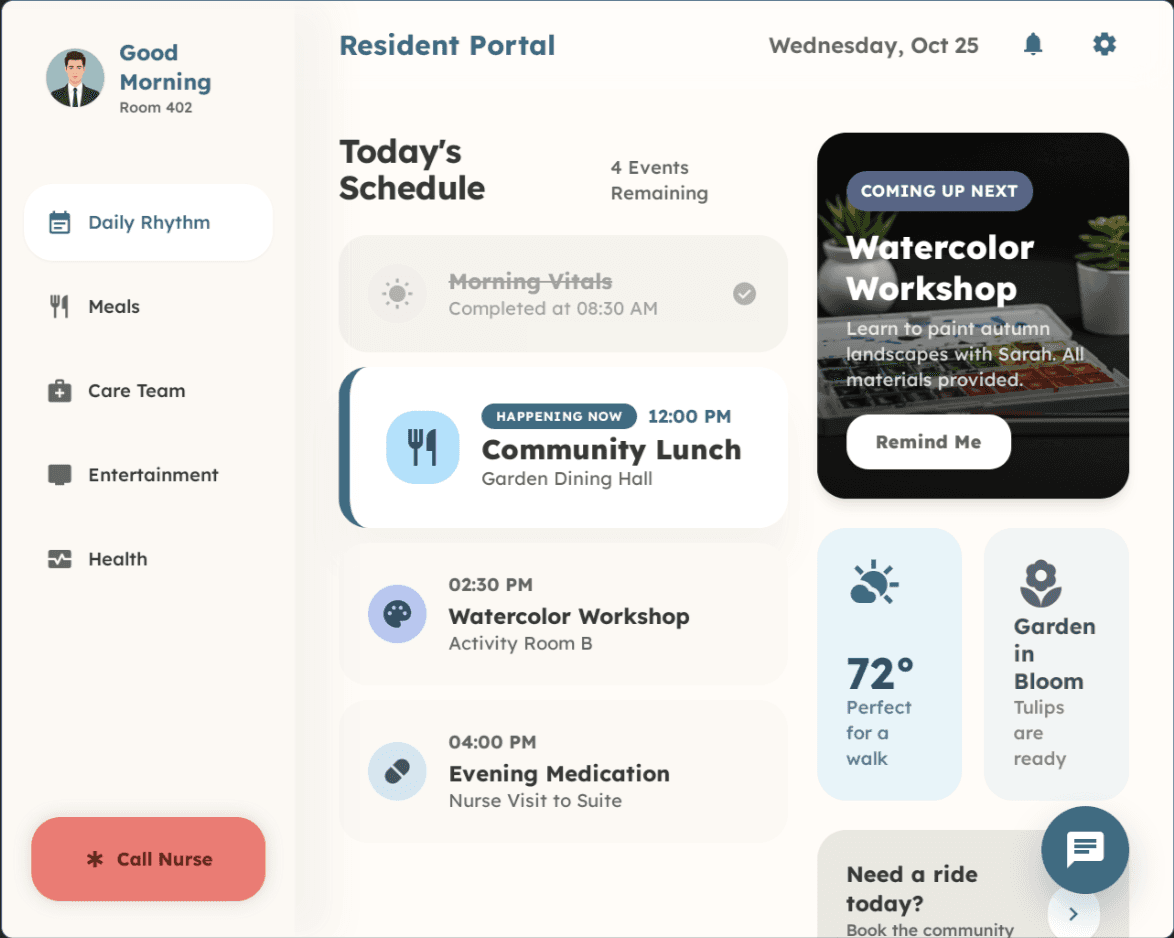
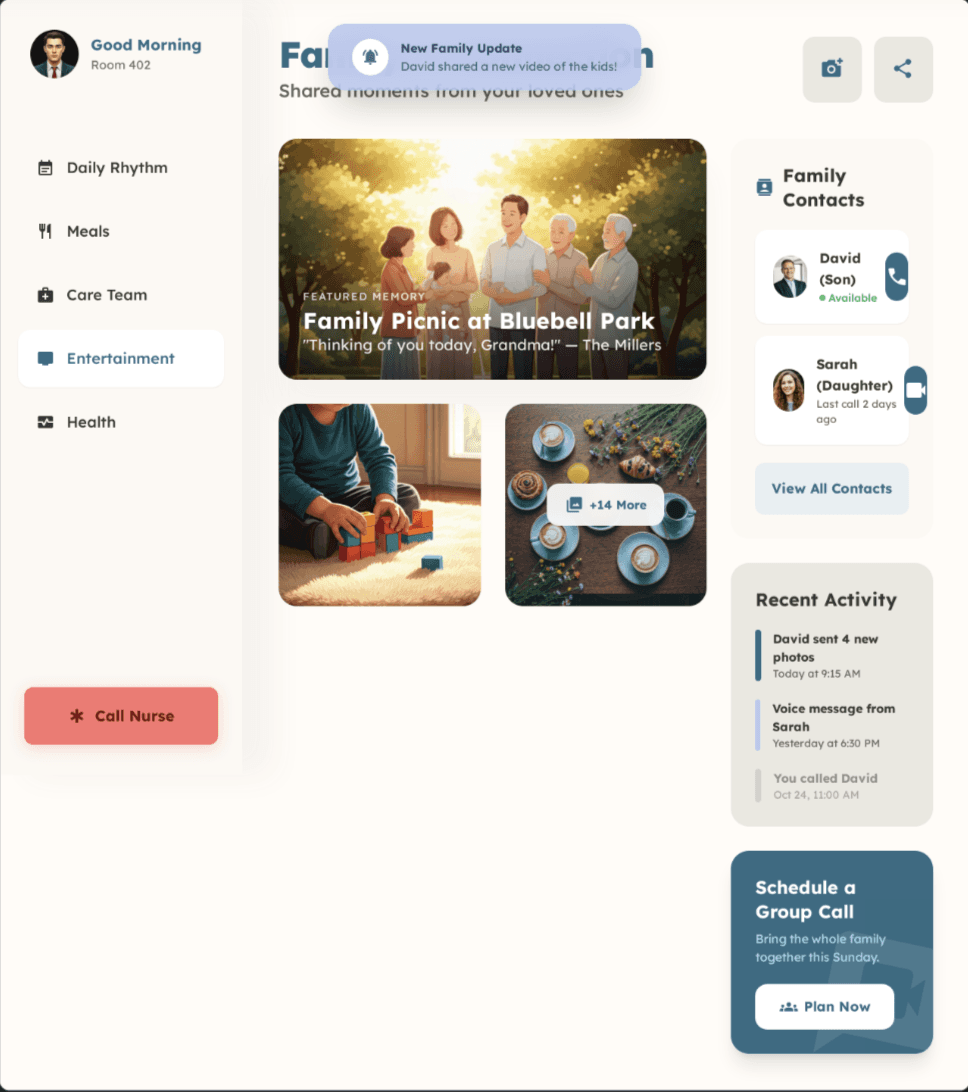
To close out the project, I gave Google Stitch, an AI UI generator, four prompts of increasing detail, from a vague one-liner to a full brief with Pebble’s name, philosophy, visual direction and target user. The goal: see where AI-generated design falls short for a population it can’t actually know.
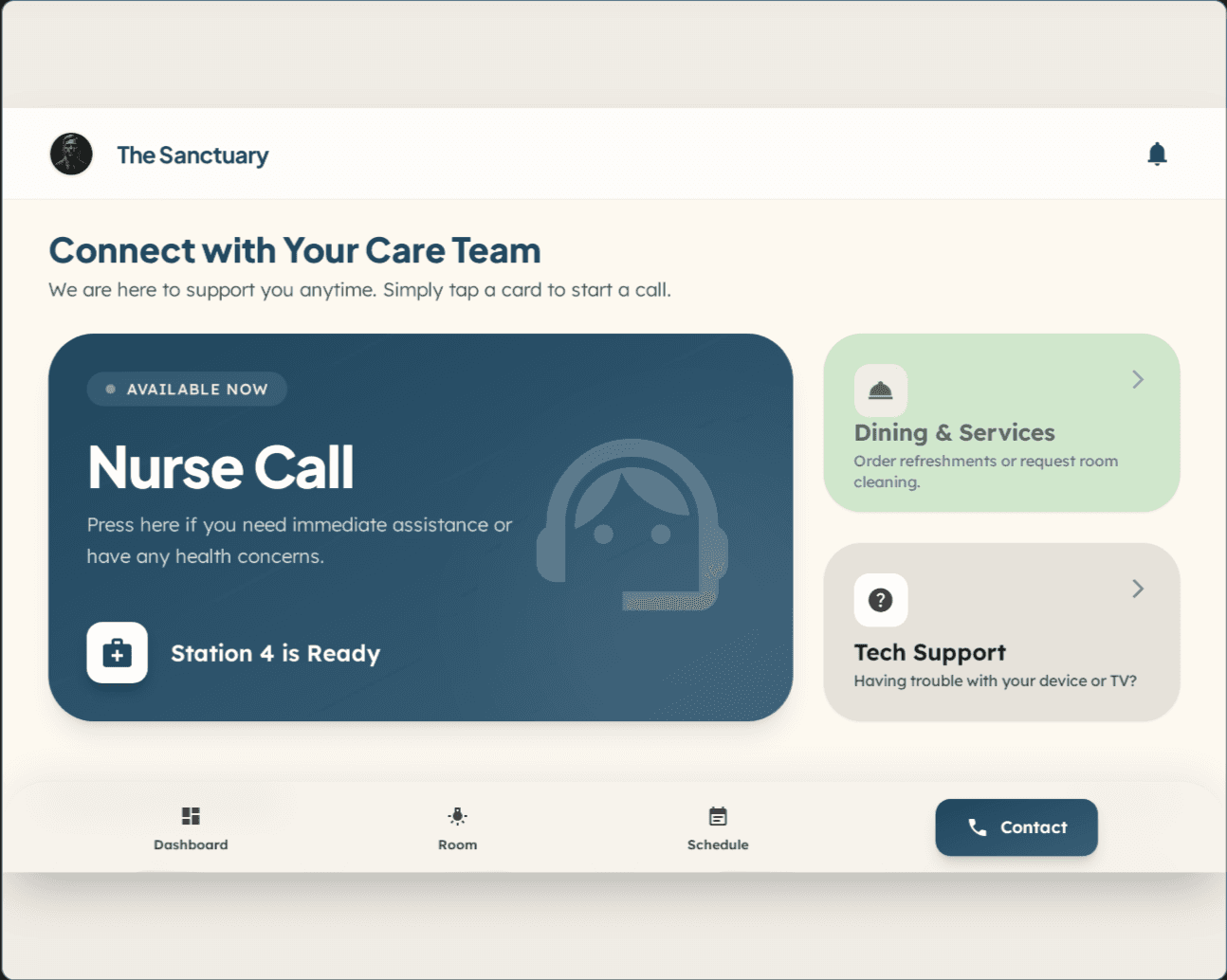
Prompt 01
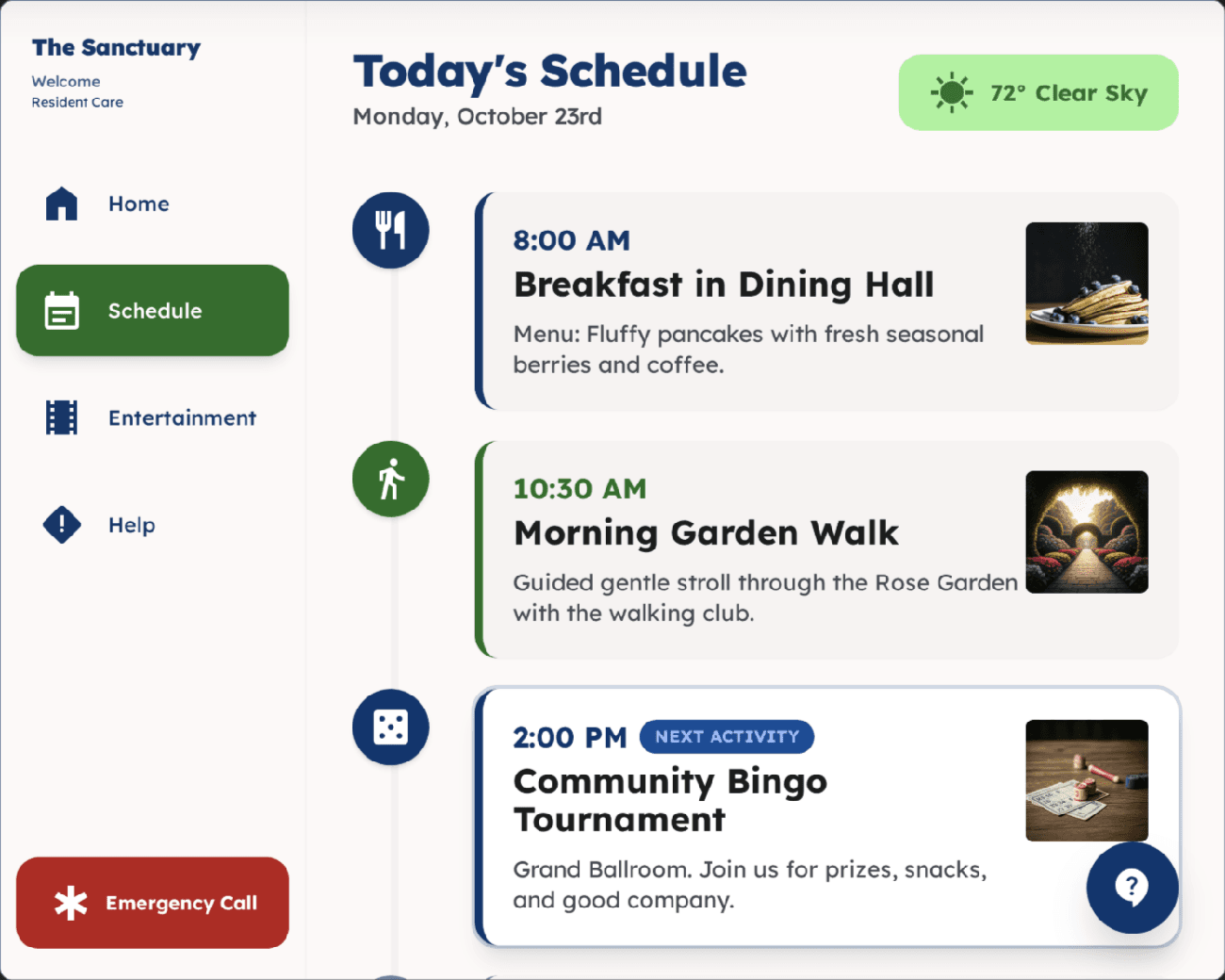
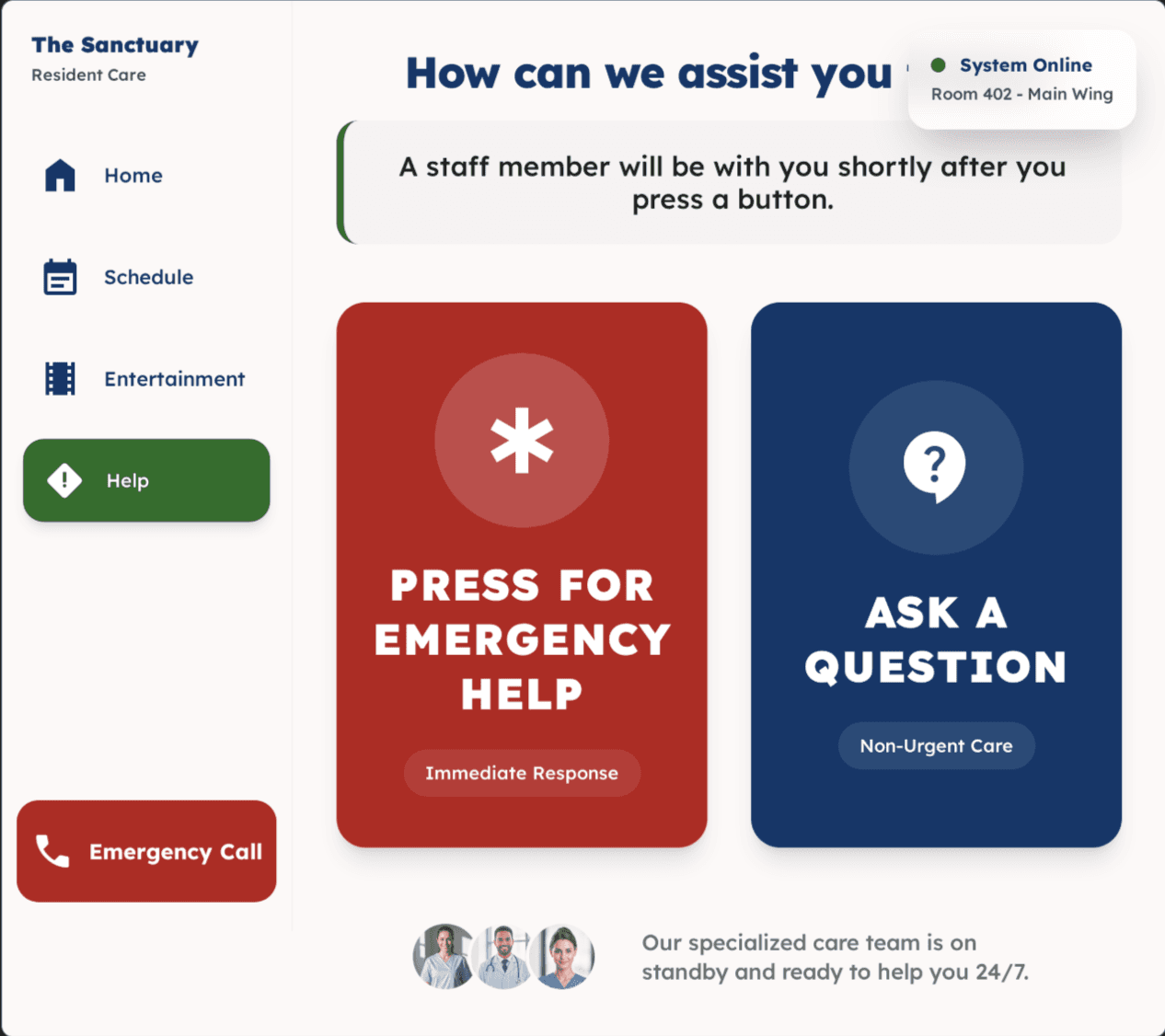
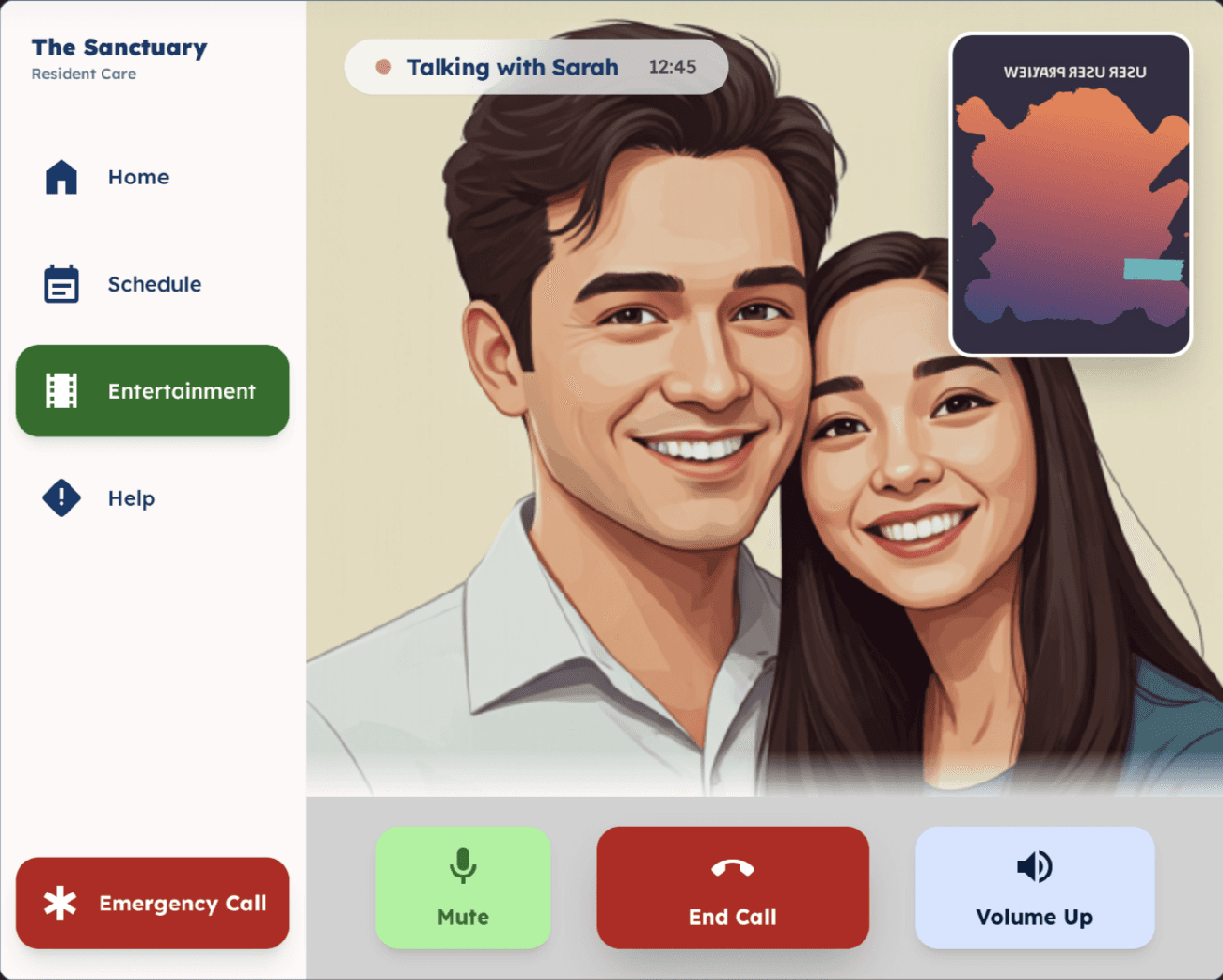
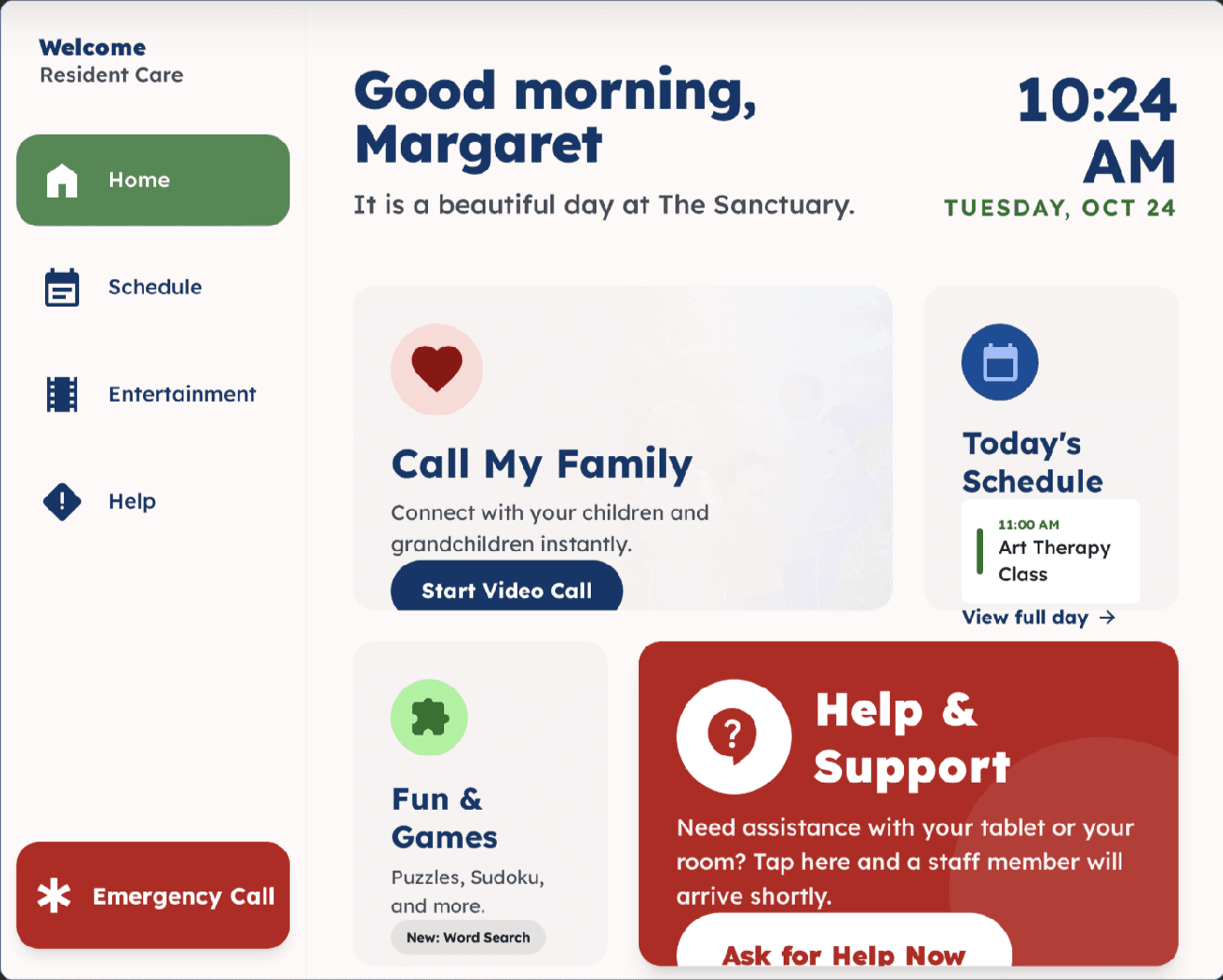
“Design a tablet interface for elderly people living in a care facility.”
A standard dashboard (home, video call, schedule, help button) with large text and high contrast, named “The Guided Sanctuary.” Functional on paper, but entirely templated. It could have been for any age group.
Prompt 02
“…help them feel more independent and in control… simple enough for someone not comfortable with technology, and calming rather than overwhelming.”
Language about empowerment showed up in Stitch’s descriptions, but the output was structurally identical to Prompt 1. Emotional intent changed how it talked about the design, not how it made decisions.
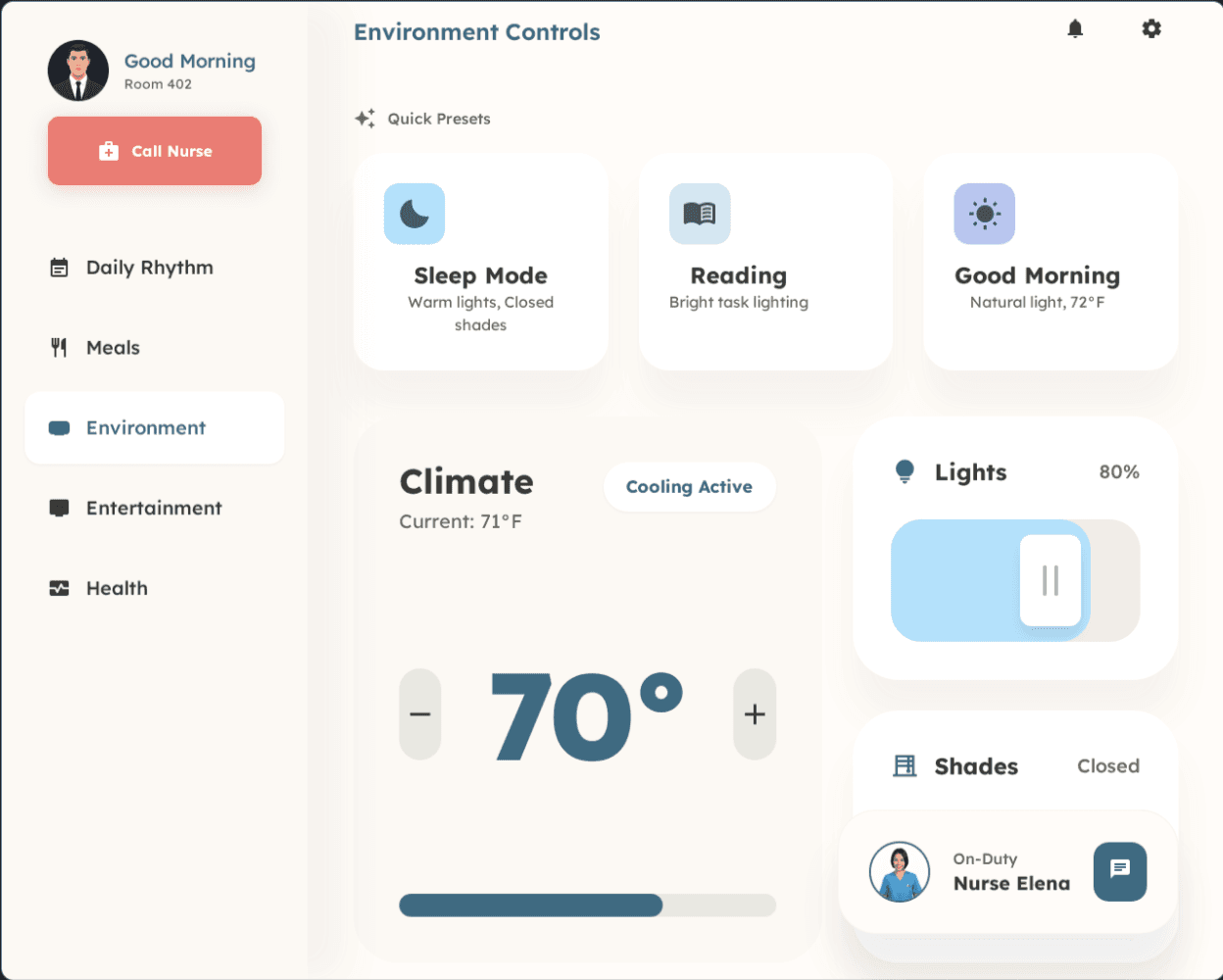
Prompt 03
“…older adults who may have vision, motor, or cognitive limitations. Non-clinical. Large text, minimal steps, soft aesthetic.”
A warmer “Tactile Sanctuary” theme, but the interface was disorienting, even to a tech-savvy reviewer. Stitch applied accessibility as a style filter, not as a lens on behavior.
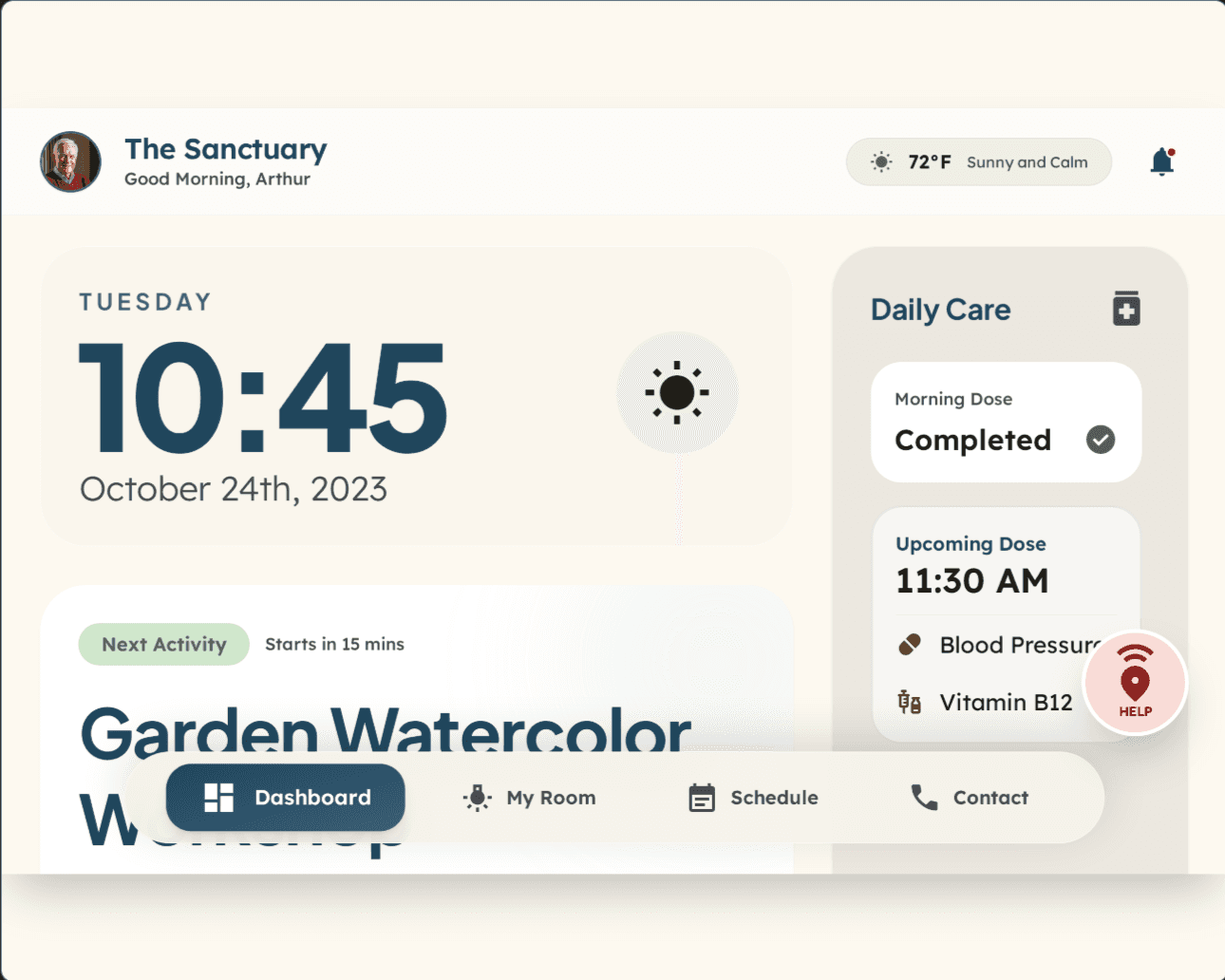
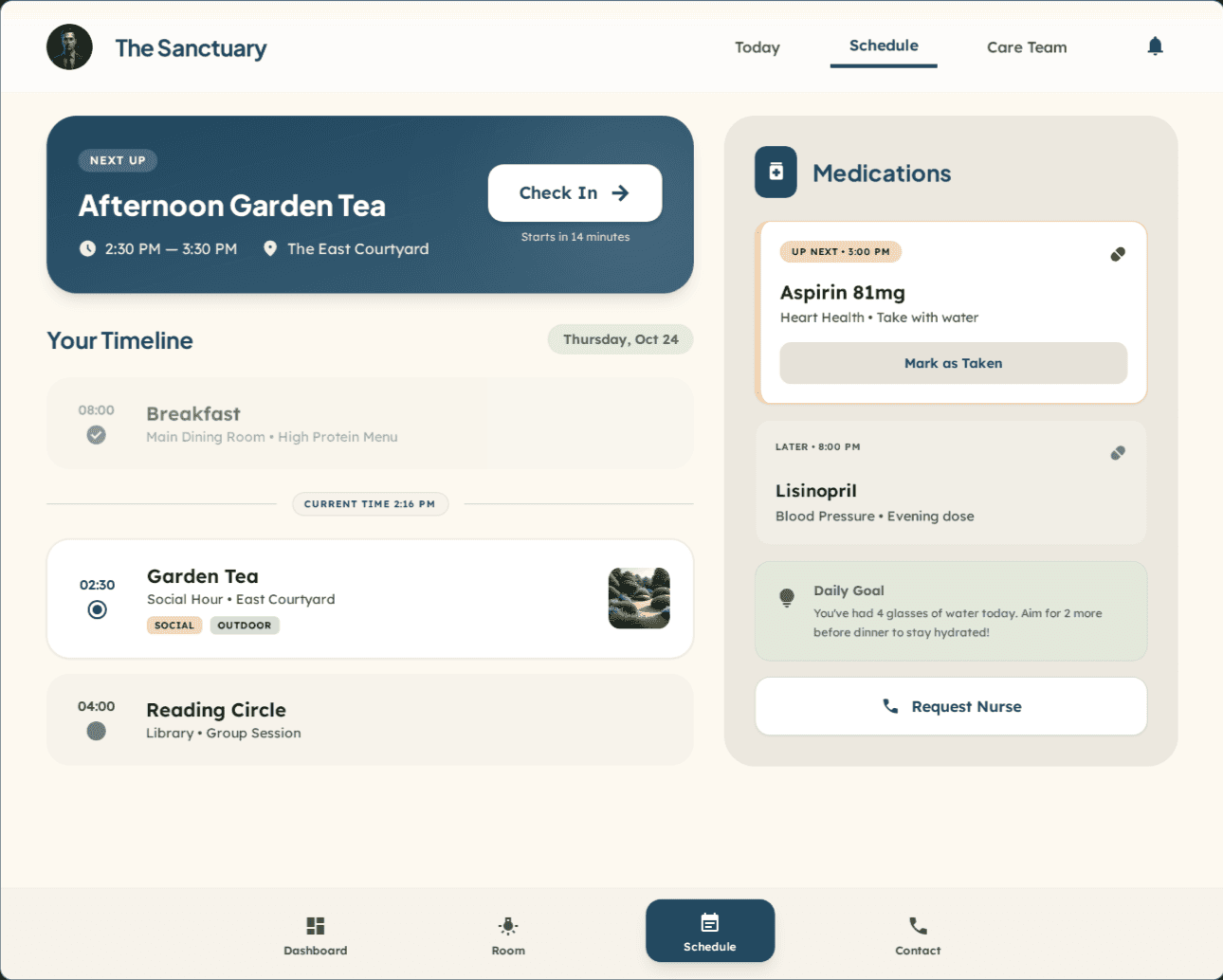
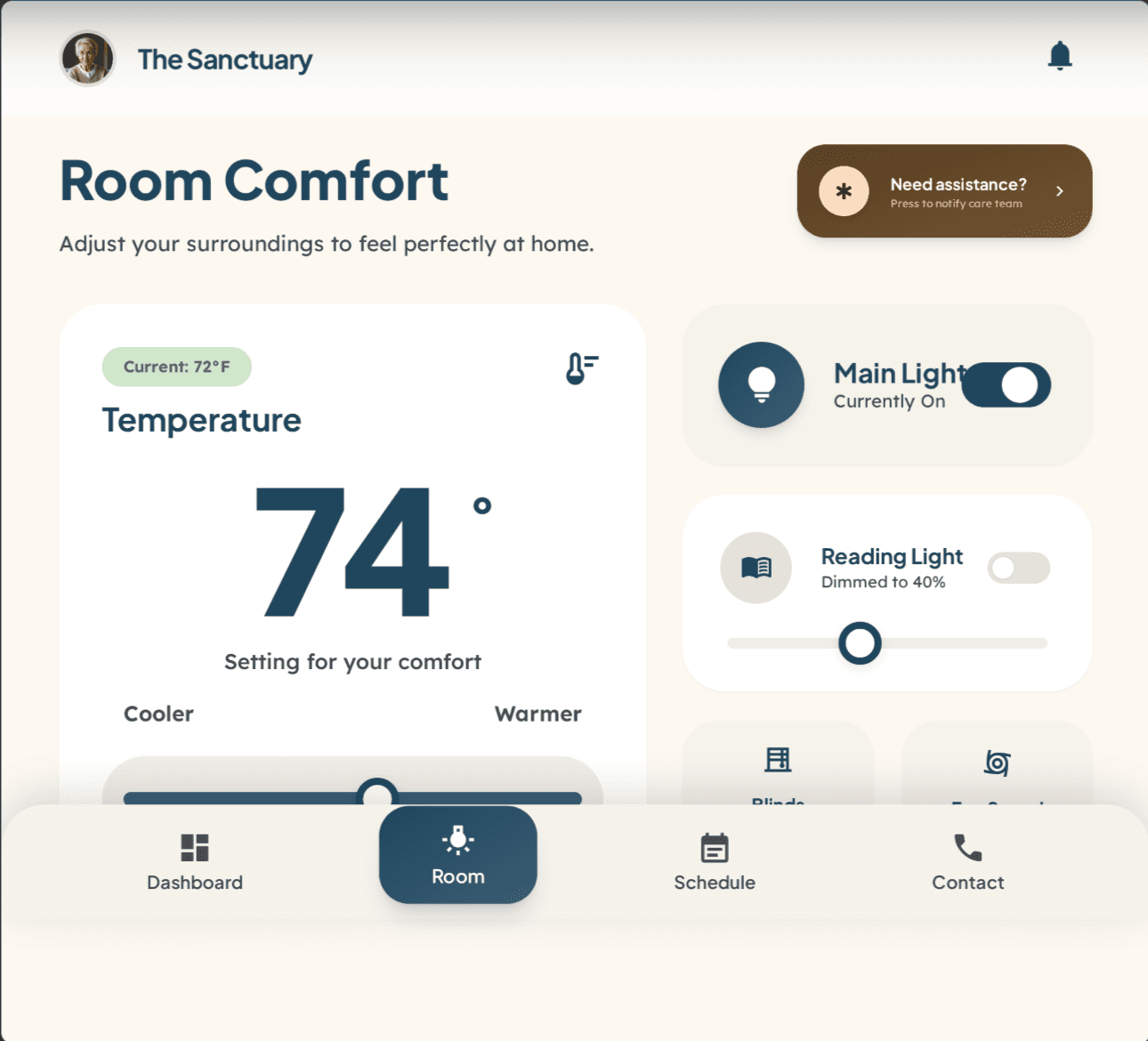
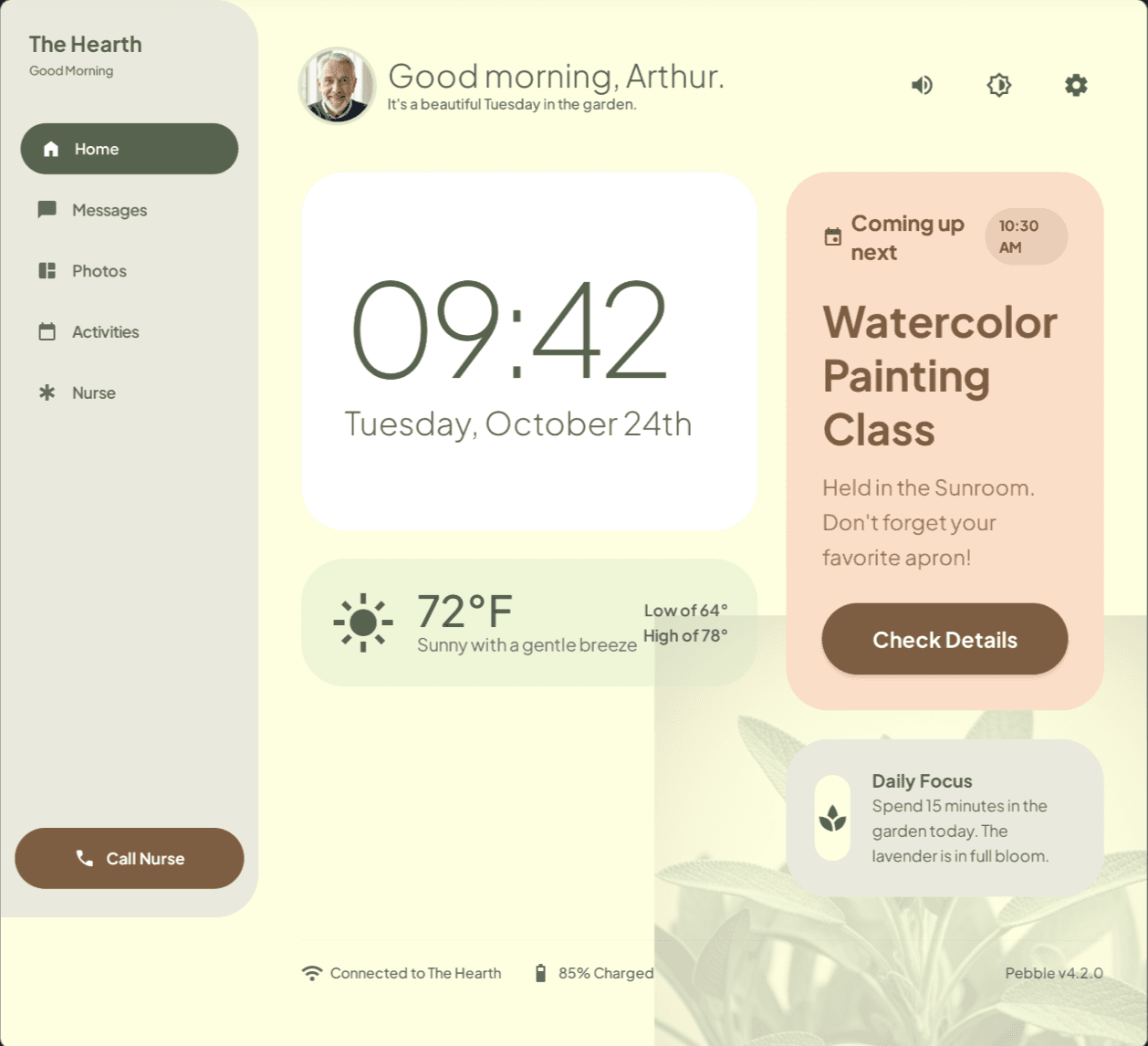
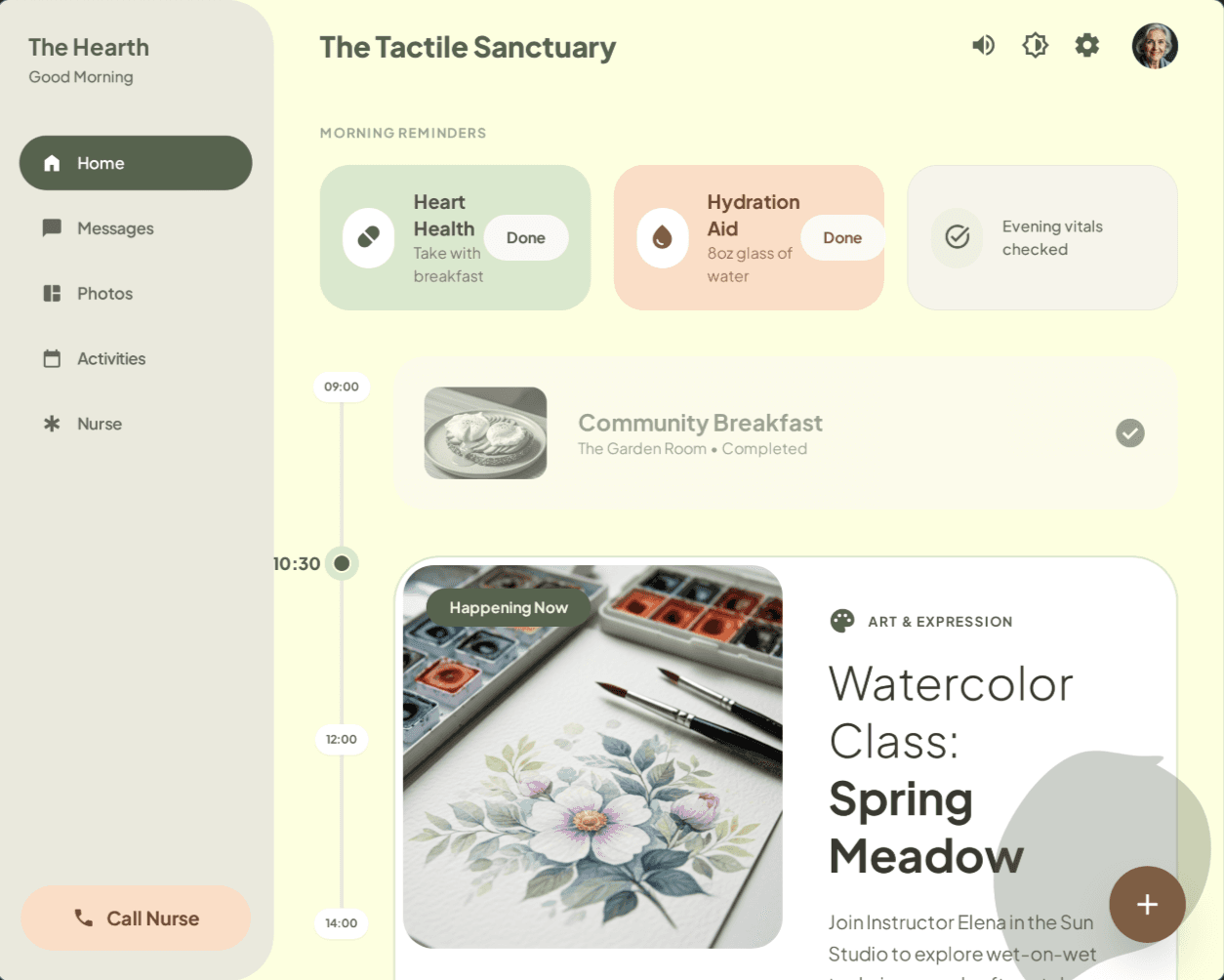
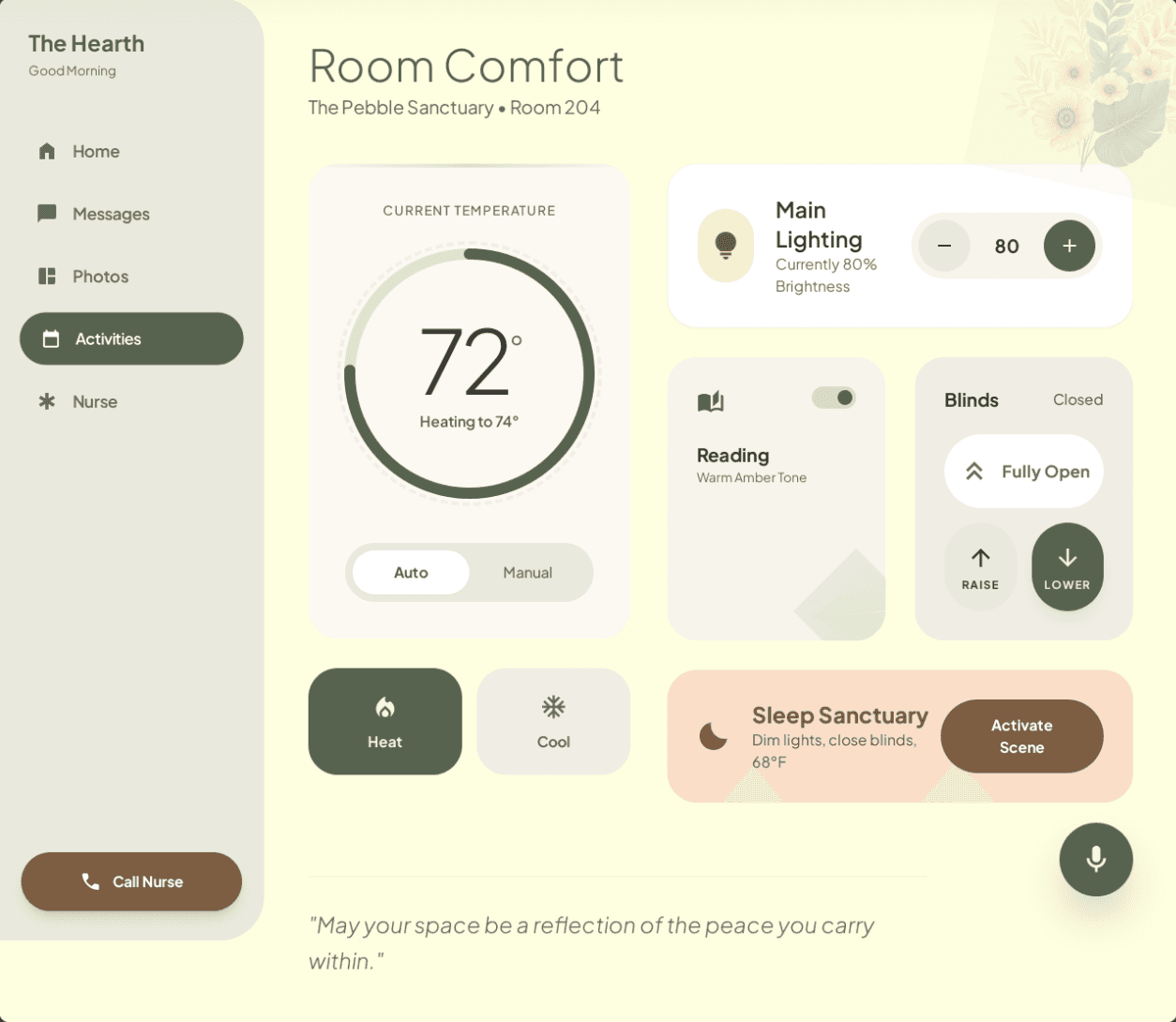
Prompt 04
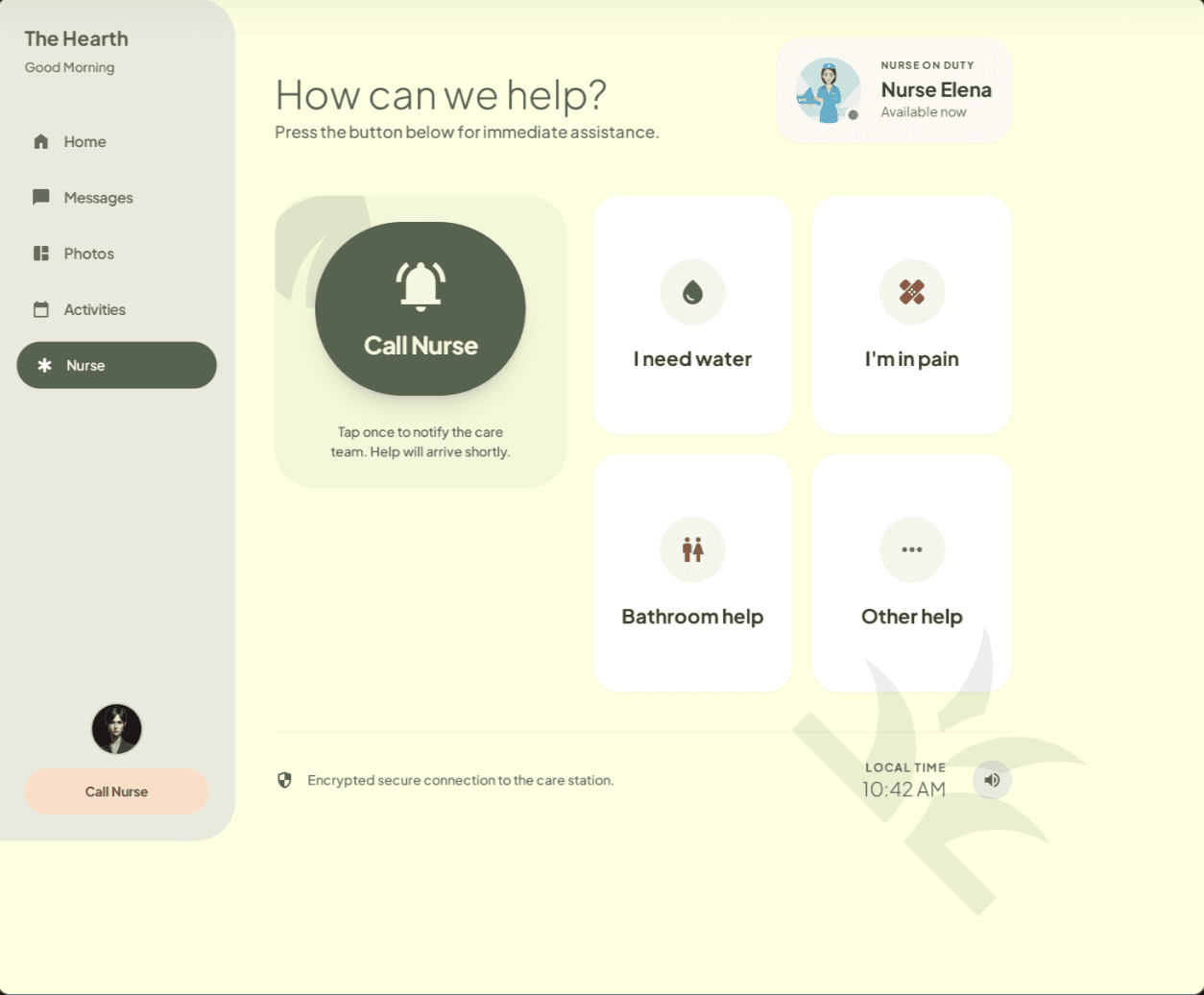
“Design a bedside tablet interface called Pebble… warm and organic: natural textures, muted earth tones, botanical illustration accents… every interaction should require as few taps as possible.”
The most refined output, a “Pebble Hearth” system with all five screens. Visually closest to the brief. Yet the gap between Prompts 1 and 4 was smaller than the gap between my first and third rounds of sketches.
What I learned
- Prompt depth ≠ design depth. Even a fully detailed brief changed surface aesthetics more than the concept. The structure of all four was nearly identical.
- AI designs for a generic user. Stitch could describe its audience in words but couldn’t design for them. Knowing a user profile isn’t understanding lived experience.
- A narrow range. Layouts, patterns and visual language converged. AI tends toward the mean; good design often has to diverge from it.
- Aesthetics without empathy. It could apply “warm” as a filter, but not decide to frame privacy as personal preference instead of a medical setting. That takes understanding dignity.
Tools like Stitch are genuinely useful for rapid scaffolding. But designing for vulnerable people takes understanding that comes from research, experience and real interactions, something AI has yet to replicate.